Are Religious Societies Too Religious– or Misunderstood?
“If you feel uncertain and never attend, then we will never have the opportunity to prove your fears wrong.”
Written by Jannah Kamaly, BA International Relations and History
Conservative, cliquey, and corrupt: all words that often come to mind when thinking about religious societies in a secular university. The SOAS website states that ‘SOAS is an inclusive community where individuals can freely express and practice their faith.’ So, despite what the university claims, why is there still such a stigma surrounding religious societies? An alternative understanding of religious societies emerges when speaking with members of the Catholic, Christian, and Islamic societies; one that is not just shaped by religious belief but warped by internal anxieties of conformity and external pressures of visibility.
From an outsider perspective, the internal pressure to assimilate within a religious society feels immense as students feel as though they are not ‘religious enough’ to join. This is natural, as religious societies inadvertently cause individuals to reflect on their personal religious beliefs. However, this sentiment remains particularly interesting; when interviewing the Catholic, Christian, and Islamic societies, they all came to one agreement: ‘we are open to everyone.’ In many cases, the biggest barrier to entrance is not exclusion from society members, but the individual perception of one’s own religious shortcomings, from not attending Sunday Mass to not wearing the hijab. Therefore, in this context, pressure is often self-imposed.
Misconceptions thrive upon ignorance. The Christian Union reported how one of their biggest misconceptions is that they are ‘trying to convert everyone,’ and the Catholic society ‘lacks inclusivity,’ all echoing similar issues prevalent in the Islamic society. Similar to the Pilates or the Star Wars society, religious societies aim to offer students community, guidance, and support. However, the stigma towards religious societies is often found to be asymmetrical. One would not question whether the Pilates society is ‘too committed to fitness’ or whether Star Wars society is ‘strictly exclusive’ to fans of the franchise. However, religious societies are often faced with harsher scrutiny and assumptions of rigidity.
This asymmetry reveals how religious societies are perceived differently in secular spaces, as they are tied to wider ideological and moral frameworks. The experiences shared by Catholic, Christian, and Islamic society members collectively reveal how stigma is not confined to one faith, but reflects a broader discomfort with organised belief in a secular environment. Interestingly, a non-SOAS, non-Muslim student reported how she “had a great time attending events hosted by the Isoc, such as Iftar and academic talks… everyone was so kind and welcoming, it was great to meet people from such diverse backgrounds” (Ananya, Student at Kings College London). Importantly, this highlights how stigma begins to dissolve through close proximity, meaningful conversation, and an open mindset, not when kept at an arm’s length.
These stigmas and pressures continue from external forces, where visible faith becomes controversial. Most notably, this was seen with last year’s lack of accommodation for a permanent Sisters’ Friday prayer space. The university provided the Islamic society with a solution: to use the JCR. Understandably, many SOAS students felt frustrated as it is one of the limited spaces on campus for relaxing, studying, and eating between classes, which was now completely out of bounds on a Friday afternoon. It was not the university that felt this backlash, it was the Muslim students on campus experiencing judgment from their peers. Many students reported that they also lacked ‘dignity’ whilst praying in a communal space not designed for religious worship, according to the 2024/25 SOAS Muslim Census Report. When religious identities clash with secular spatial norms, tensions rise.
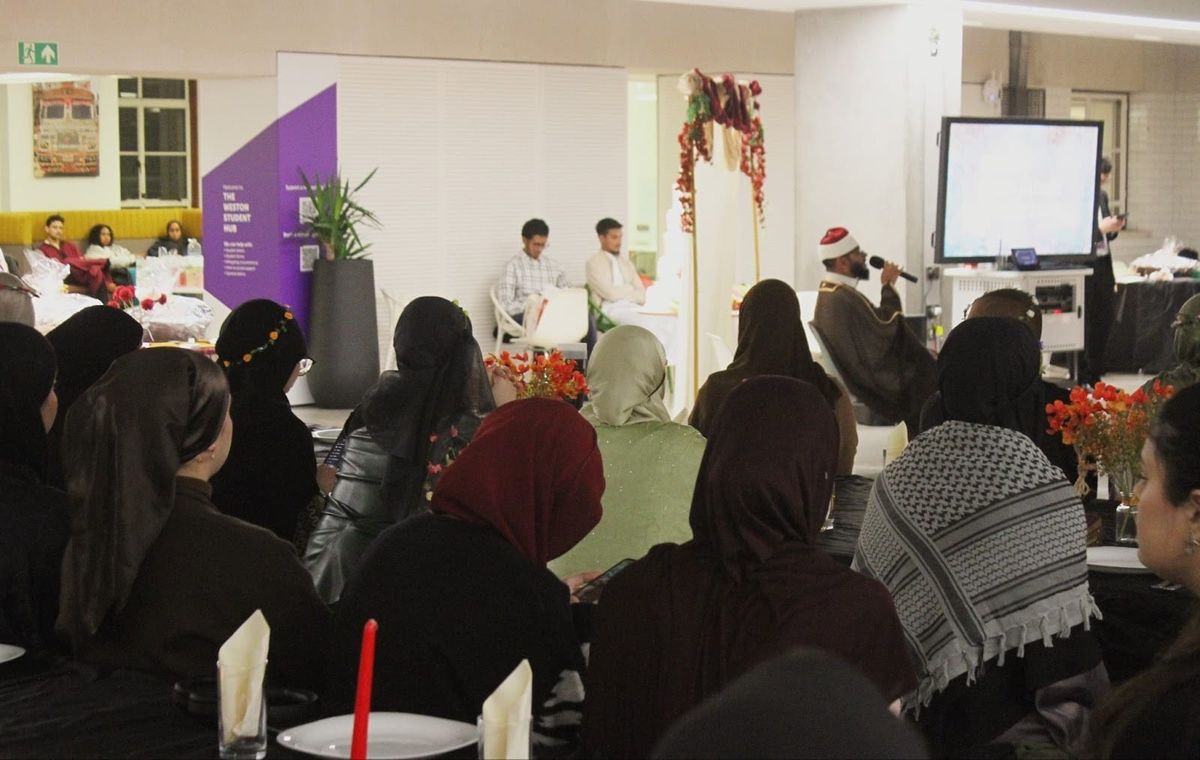
Similarly, this year, the Islamic society was met with unexpected complications during their annual charity auction dinner, an event that had been planned for weeks and agreed upon with the SOAS administration to occur in the Senate House. However, upon arrival, neither security nor the porters held any knowledge of the event, leaving society members to set up a formal dinner for over 50 students whilst negotiating access to the space. The incident was eventually resolved. However, it generated visible frustration from attendees, security, and students who had already been using the area. Despite the administrative shortcomings, frustration is often directed towards the students rather than the managerial structures that failed to coordinate and communicate. At a visibly religious event, it left the Islamic society under a harsh eye of scrutiny. This institutional friction puts religious societies in a vulnerable position as it involuntarily reinforces the very stigmas that these societies are attempting to challenge.
As a member of the Islamic society, I have witnessed these harsh prejudices, stigmas, and anxieties firsthand. On the other hand, I have also seen the astonishing community, guidance, and support that religious societies contribute towards university life, which can often feel isolating. If you are reading this and still hold a misconception about religious societies, I urge you to take this statement from Nivea, a member of the Catholic society, to heart: ‘If you feel uncertain and never attend, then we will never have the opportunity to prove your fears wrong.’