Narratives of Power: The Parallels of Zionism and Hindutva
"Both movements normalise the idea that certain groups are inherently ‘other’, justifying exclusion and violence."
Written by Maryam Qutbuddin, MA History
If observed carefully, many parallels can be drawn in the techniques and ramifications of Zionism and Hindutva. Rather than mere coincidences these are conscious efforts and sharing of methodologies through complex relationships. Zionism is a nationalist movement advocating for a Jewish homeland, and Hindutva is a nationalist ideology seeking to define India as a Hindu nation. Ultimately the goal of this analysis is not to compare, but to connect the dots and understand how oppressors align.
Media suppression and manipulation, and the parallels of Zionism and Hindutva (Hindu nationalism), are clearly observable today if examined closely. These strategies are particularly apparent within the context of the rise of global fascism. Misinformation, amplified by political authority, feeds communal tension and real-world violence, clearly ongoing in both Palestine and India. This process is rarely accidental; it is cultivated and embedded until prejudice feels like common sense rather than propaganda. In the Palestinian context, the demonisation and dehumanisation of Palestinians mirrors similar mechanisms, showing how authoritarian narratives are normalised through media ecosystems, rather than imposed solely by force. Understanding how these narratives intertwine and support each other, and ultimately why they resonate so effectively, is a crucial step in dismantling them.
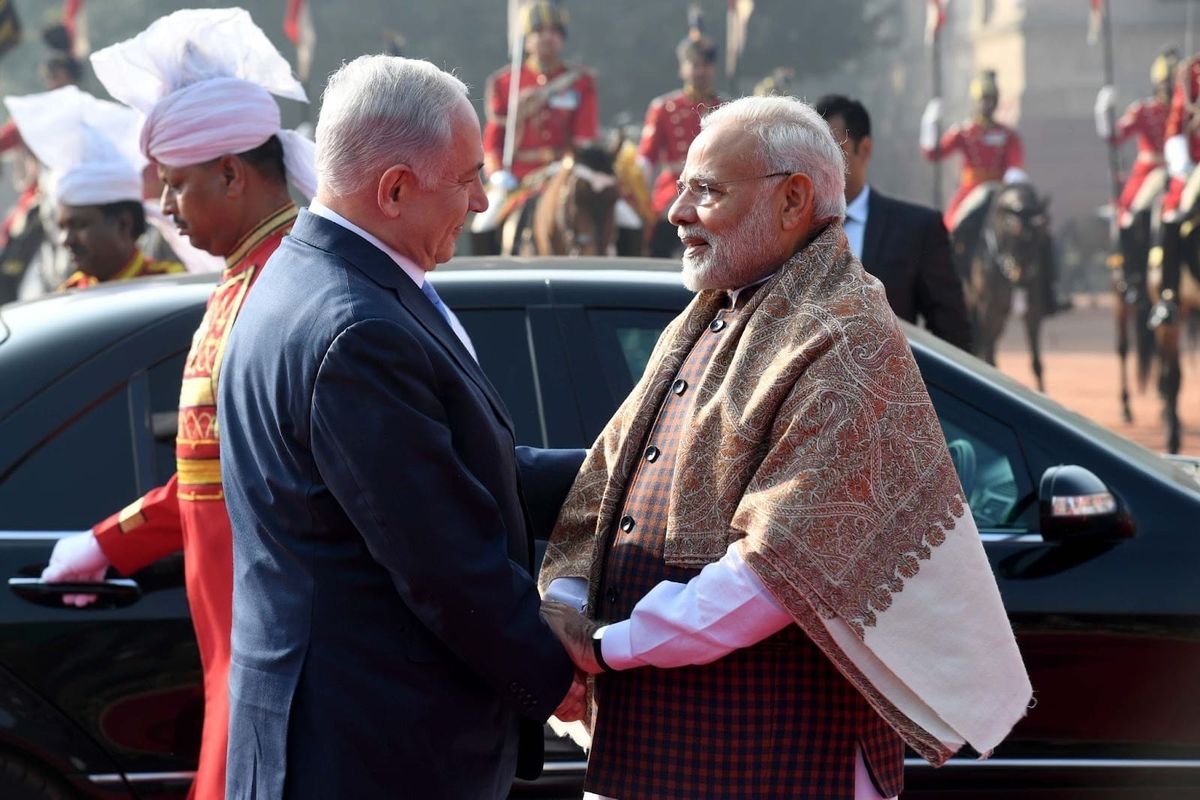
The ideological alignment between Hindutva and Zionism extends beyond ideas into tangible cooperation and operational strategies. As explored by journalist Azad Essa in ‘Hostile Homelands: The New Alliance Between India and Israel’, the modern India–Israel relationship has gone beyond being strategic or transactional. It reflects deeper ideological convergences between Hindutva and Zionism. Essa shows how India’s foreign policy shifted from early support for Palestine to making Israel a central partner, and how both movements’ ethno‑nationalist logics have become intertwined in practice. The ideological links between early Hindutva and Zionism run back to their founding thinkers. Vinayak Damodar Savarkar, founding thinker of political Hindu nationalist ideologies, explicitly praised Zionism’s fusion of ethnic and religious nationhood, supporting the realisation of their goals. His successors in the RSS likewise viewed Jewish nationalist revival as a compelling model for a Hindu nation, embedding a framework of ethno‑religious statehood into Hindutva’s intellectual history. Military and strategic connections reinforce this convergence. Journalist Mehdi Hasan highlights the trade in weaponry, noting India is consistently ‘buying billions of dollars worth of weapons parts from Israel’, while also shipping weapons to Israel.
While the historical and political contexts of Zionism and Hindutva are also distinct, their strategies intersect. Both movements normalise the idea that certain groups are inherently ‘other’, justifying exclusion and violence. Arundhati Roy, a prominent Indian writer, notes in an interview, the ‘uncanny’ similarity between these patterns, asking: ‘is there a real playbook… how is it always the same, the echoes?’ In both contexts, the narrative constructs a moral universe in which majority violence is rationalised, and extreme rhetoric becomes normal. Mobs can say ‘Muslims should be killed… and it’s normalised.’ At the same time, Roy also reflects on the broader authoritarian logic of ‘these countries that claim to be democracies are running these militarised occupations,’ noting that the law often applies differently depending on religious identity. For example, to quote Roy, ‘In India if you are Muslim the law applies to you differently… undeclared but that is how it is.’ Ilan Pappé’s insight, that communities can become racist to deal with the racism they themselves deal with, underscores how these dynamics feed systemic prejudice and forge pathways to genocide, while opposing them remains difficult. Roy summed this up pertinently when asked how the narrative could be countered, referring to Netanyahu, Modi, and other leaders who attempt to project an aura of invincibility and inevitability. Roy replied that it is “not one big battle that has to be won" but continued use of humour, daily life, art, and to keep telling them ‘your tiny little minds will tire.’
Despite ongoing suppression, the taboo surrounding these narratives begins to erode, with their devastating consequences also becoming increasingly visible on social media. Connecting these dots reveals how systems of oppression reinforce one another across borders, and how solidarity can travel just as powerfully.