The Bad Bunny Halftime Performance Was a Show of Resistance Through Celebration
“I think we'll all be grateful to Bad Bunny until the day we die”
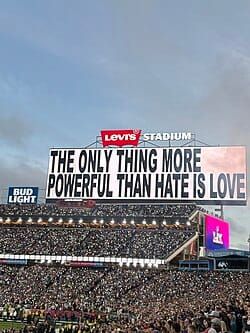
Written by Kristi Greenwood, Contributing Designer, BA Japanese
Benito Antonio Martínez Ocasio, stage name Bad Bunny, made history performing at the Super Bowl halftime show entirely in Spanish. Through vibrant storytelling, he celebrated and paid homage to his motherland of Puerto Rico, bringing neighbourhoods, people and history to life. From the los abuelitos playing dominoes, songs from the plena, reggaeton and bomba genres also rang out throughout the performance. He also highlighted the fighters of gentrification center-stage, such as Maria Antonia Cay, who owns the iconic Latino social club Toñita’s in Williamsburg, Brooklyn. Unity and community are brought to the ‘biggest party in the world’, as Bad Bunny says, resistance through hope echoes true throughout the entire performance, with heavy symbolism portraying the ‘luchador’ spirit of Puerto Ricans.
The opening shot of the performance transports us back to Spanish colonial times of Puerto Rico, with a panoramic view of sugar cane fields. Among them, we encounter Alexander Mercedes, a Dominican artist, who exclaims ‘qué rico es ser latino’ (‘how wonderful it is to be latino’) and echoes the popular phrase ‘hoy se bebe’ (‘today we drink’), a reference to a bachata melody of a fellow Dominican artist, Antoni Santo. From the onset, the performance situates Puerto Rico within a larger Latin American lineage. Sugar cane was brought to Puerto Rico, formerly known as Borikén, in the 16th century by the Spanish colonisers. Enslaved Africans worked the sugar plantations until abolition in 1873. In 1898, the United States took the island by force, asserting itself as the new colonial power of the Western Hemisphere with no intention of relinquishing any of the sugar-producing islands. The U.S. poured in private companies, and by the early 1900’s, American corporations and banks had transformed almost half of the agricultural land into sugar plantations. Syndicates controlled almost everything, from roads and postal services to sea ports. Puerto Rico had been passed from one imperial power to another and in the words of Luis Muñoz Marín (a former governor), has been reduced to ‘Uncle Sam’s second largest sweatshop.’
When ‘VOY A LLeVARTE PA PR’ plays, an old-school reggaeton tribute ensues, sampling Tego Calderón, Dale Don Dale by Don Omar, Noche De Travesura by Héctor El Father, and Gasolina by Daddy Yankee. Reggaeton has long been dismissed and reduced to ‘twerking’ music in the West, but reggaeton is long-rooted in its working-class, anti-government sentiment and proclamation against systemic racism. Originating in the 1980s, when Afro-Antillean communities in Panama began translating Jamaican dancehall, soca and reggae into Spanish, they added Spanish flows over Caribbean rhythms. This would later take hold in Puerto Rico’s most marginalised communities as a cultural outlet, particularly in public housing neighbourhoods. Reggaeton has been victim to intense censorship and criminalised by conservative elites and the state, yet it persists and evolves. This tribute culminates in Benito’s modern interpretation of the genre with ‘EOO’, where he declares, ‘estás escuchando música de Puerto Rico, de los barrios y los caseríos’ (‘you’re listening to music from Puerto Rico, from the neighbourhood and the housing projects’), reclaiming reggaeton’s origins as a voice of the people.
On the big screen appears Sapo Concho, the Puerto Rican crested toad, the only native toad species to Puerto Rico, which is now critically endangered as a result of the invasive cane toad, Rhinella Marina. Originally introduced to the island during the early to mid-20th century to reduce agricultural ‘pests’ to sugarcane, this toad species quickly took over most of the crested toad’s breeding grounds and key food sources. The Sapo Concho represents Puerto Rican identity: native, resilient, yet increasingly endangered. In the same manner, foreign investment threatens to displace local communities.
The opening of ‘LO QUE LE PASÓ A HAWAII’ (‘what happened in Hawai’i’), performed on el cuatro, the national instrument, and sung by the golden boy of Puerto Rico, Ricky Martin, is performed on the staple plastic chairs, found at every community event, party and street. The song is an anthem of resistance, drawing direct parallels between Hawai’i and Puerto Rico, both victims of U.S. imperialism. They take the land, erase the culture, and displace the local people to create ‘luxury’ resorts and tourist attractions. As Boricua feminist educator Andrea C. Zambrana Rosario reminisces on the performance: ‘When I first heard it, I cried. I think we'll all be grateful to Bad Bunny until the day we die, honestly.’ Since the enactment of Act 60 in 2019, which allows wealthy ‘mainlanders’ to move to Puerto Rico and pay nothing in tax, the issue has intensified. An ongoing project encompassing the sentiment of the song in Puerto Rico is Project Esencia, a two-billion-dollar development project spanning three square miles of land, alongside three miles of beach for 900 ‘elite’ residents. The private ‘city’ will have an airport, five hotels, two golf courses, and schools, all behind walls, shielding wealthy foreigners from the issues plaguing native Puerto Ricans, rooting out the local people and devastating the natural wildlife. The U.S. has never had well-meaning plans or policies to encourage economic development for Puerto Ricans-just a series of tax shelters for well-connected corporations. This sentiment is made explicit in the lyrics of the song: ‘Quieren quitarme el río y también la playa…No suelte’ la bandera ni olvide’ el lelolai’ (Thеy want to take my river and my beach too…don’t let go of the flag nor forget the lelolai’). Without Kanakas, there is no Hawai’i; without Puerto Ricans, there is no Puerto Rico.
Benito then emerges waving the original Puerto Rican flag with the light blue triangle, which was outlawed in 1948, referenced in his song ‘LA MuDANZA’; ‘Here, people were killed for raising the flag, That’s why I carry it everywhere’. The flag was decriminalised in 1952 but adjusted to the blue present in their occupiers’ flag.
Surrounded by sparking and smoking utility poles, ‘El apagon’ (‘the blackout’) is a song of protest, referring to the frequent blackouts which plague the island due to poor infrastructure, especially prevalent after Hurricane María devastated the grid in 2017. Investigations found the Trump administration guilty of delaying $20bn in aid to Puerto Rico, with another study reporting that Puerto Rico received significantly less federal aid than Florida and Texas. FEMA (Federal Emergency Management Agency) was later found to have mismanaged about $257 million in relief for Puerto Rico. Puerto Rico was devastated, the hurricane had claimed the lives of 4645 Puerto Ricans. In San Juan, a memorial was held outside El Capitolio, Puerto Rico’s capital building, where thousands of pairs of shoes were placed to honour the fallen. In 2021, Puerto Rico handed control of the power grid to LUMA Energy, a private company which has since received billions in contracts meant for improving electrical infrastructure. Still, they have yet to improve the grid, and Puerto Rico still faces widespread power blackouts and growing public frustration.
Reactions worldwide were emotional and passionate, with users reiterating why representation matters. One X user from Caracas stated: ‘He's demonstrated the Latino spirit, in what we are, who we are, where we come from… that we are fighters’. Speaking to Andrea C. Zambrana Rosario, she explains that the performance ‘gave me hope…this is the first time an artist of this scale is from your country–someone who wasn’t born rich, who grew up in a local neighbourhood of Puerto Rico’. She adds, ‘We have resisted more than 500 years of colonialism [yet] we have lost some things, we don't speak the native tongues of Puerto Rico, and the name isn't even Puerto Rico’. She adds that Benito’s unapologetic visibility at the Super Bowl challenges the island’s long colonial erasure, making Puerto Ricans feel ‘a lot of pride’ and affirming the ‘la lucha of Puerto Ricans’.