The Meteoric Rise and Transformation of the Green Party
Lilac Carr, BA Politics and International Relations
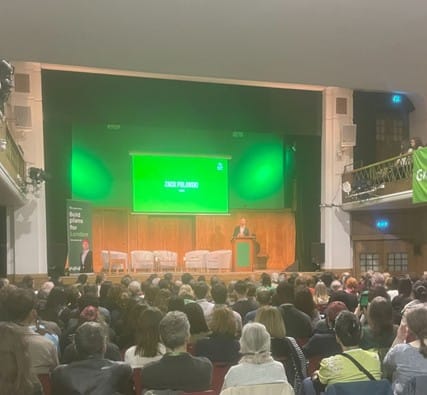
On the 2nd Of September, Zack Polanski was elected leader of the Green Party of England and Wales. Since then, the Greens have surpassed 150,000 members and consistently rank second in polling at up to 18%, becoming the leading voice of the UK left.
A significant amount of this support comes from younger people, with the Green Party leading in polls amongst ages 18-24. The youth wing of the Green Party, the Young Greens, has recently become both the largest youth wing of any political party in the UK at 40,000 members (far above Labour’s 30,000 in second place), and the largest youth wing of any Green party in Europe.
The rise of the Green Party marks a significant shift in the UK political landscape as the Labour Government has shifted to the right in policy and rhetoric alongside pressure from the Reform Party, which is currently leading in polls. In stark opposition to current government policy, the Green Party supports a policy of widespread nationalisation including the water and energy sectors; economic distribution including a wealth tax on the ultra-rich; consistent support for refugees and migrants, Palestine and trans rights.
While much of this policy has been the consistent stance of the Green Party for many years, the election of Zack Polanski also marks a transformation of the Green Party into a more openly and radically left-wing political force. Polanski campaigned for leadership on what he refers to as an ‘eco-populist’ agenda of mass transformation, which centres everyday people’s concerns - especially economic issues and the cost of living crisis, but also connected concerns around inequality, discrimination, and injustice - in a broader left-wing environmentalist political package. Describing his approach to politics in a CNN interview, Polanski described his form of populism as ‘the 99% versus the 1% - the working majority against a tiny elite that has taken our power and wealth.’
This is in contrast to the previous Green Party approach - which his leadership opponents Ellie Chowns and Adrian Ramsey supported - which sought to address these issues while centring the climate crisis and local issues in a rhetorically softer, more incrementalist, council-focused approach.
As a result of this change, much of the Green Party’s new membership consists of either those who have found themselves previously unrepresented by any major political party or who have become disaffected by the Labour Party’s rightward shift and suppression of the Labour left.
Owing to the Green Party’s internally democratic political structure, in which members determine party policy, this influx of left-wing members has resulted in the party’s adoption of increasingly left-wing policy, reflecting the party’s shift in direction. Some recently adopted party policies include the proscription of the IDF as a terrorist organisation, and the abolition of landlordship through a range of left-wing housing reforms, including rent controls and giving councils the right to buy rented housing in various circumstances. This puts the party to the left of other centre-left and left-wing UK political parties including SNP, Plaid Cymru and even the (still largely prospective) ‘Your Party’, established by a mixture of former left-wing Labour MPs and pro-Palestine independents, who have softer stances on either foreign policy and/or housing.
The rise of the Green Party comes in the context of an increasingly unpopular Labour government and the prospect of an end to the traditional Labour-Conservative two-party system, with the two parties currently polling under 40% combined.
Historically, the First-Past-the-Post voting system used in the UK, in which the party with the plurality of votes in a single constituency wins a single seat, has made it difficult for third parties such as the Liberal Democrats, Greens or UKIP to compete electorally with the two major parties. The rise of the Greens and Reform - amidst successive catastrophic loss in support for the Conservatives and Labour - suggests this may be changing, with the two traditional parties of the right and left being replaced by their respective populist alternatives, which could be considered, alternatively, more radical or extreme than their traditional counterparts.
The Greens, as well as most third parties in the UK, have been consistent advocates for electoral reform, advocating for a proportional representation voting system, or PR, in which the proportion of seats of each party would more accurately reflect their number of votes. This would put the UK in line with most European states, which traditionally have multiple politically viable parties and electoral coalitions. Zack Polanski has long been an advocate of PR, having previously been a spokesperson for the national PR campaign, ‘Make Votes Matter’. In a Novara Media interview, however, he stated that while he and the Green Party are strong supporters of PR, he would ‘not do anything that makes Nigel Farage Prime Minister’ in the event that proportional representation would result in this outcome, declaring it as a ‘red line’.
While the Green Party currently only have four MPs in parliament, their staggering rise in popularity and support has drastically emboldened the party and their ambitions, with the party setting its eyes on government at the next election. In an interview with ITV News, Zack Polanski stated that while only a few weeks ago his aim had been thirty to forty seats at the next general election, he now felt that number was ‘starting to look unambitious.’ His and the party’s electoral success, then, may lend credence to Zack Polanski’s bold declaration in his leadership acceptance speech directed to the Labour Party, that ‘We’re not here to be disappointed by you, we’re not here to be concerned by you, we are here to replace you.’