Beyond Victimhood: How Cinema from the Global South is Rewriting the Narrative of War.
Midnight Adams, MSc Humanitarianism, Aid & Conflict
For almost a century, America has dominated filmmaking and dictated the narratives we are taught. In what critics call the Western gaze, cinema becomes a tool of propaganda - dehumanising and tribalising the ‘enemy’. Lacking in understanding of the diversity within the Global South, the Western gaze reduces hundreds of unique cultures and experiences into generalised portrayals of hardship.
One need look no further than American Sniper (2014) where Iraqis are presented as one-dimensional ‘savages’, rather than human beings. This continues today. A24’s Warfare (2025) reminded us that the West is still dictating the narratives of conflict through an American lens, ignoring the voices of the oppressed.
However, a narrative shift is underway. The Global South is reclaiming authorship beyond mere portrayals of victimhood, turbans, and sepia colour palettes. These filmmakers are not simply documenting suffering; they are reclaiming narrative power. Their art protects memory, resists colonial erasure, and restores the subaltern voice. Without these interventions, dominant narratives of war remain biased, partial, and distorted by the colonial lens.
In Cinemas of the Global South, scholars Dilip Menon and Amir Taha suggest the Global South’s aesthetic blends resistance, decolonisation, virtuality, creativity, entanglement, and affect. They propose that these components are intertwined and shared across communities, as a result of the brutalisation of colonialism. In contrast to Western depictions of heroic, rapid-paced battles, the Global South prioritises endurance. There is a greater focus on everyday life, and less of a tendency to glamourise war.
In the Global South’s fight to reclaim cinema, no film has received so much attention as No Other Land (2024), the Oscar winning Israeli-Palestinian film, depicting the ethnic cleansing of Masafer Yatta. While heralded for its honesty, No Other Land has faced extensive criticism. The Palestinian Campaign for the Academic and Cultural Boycott of Israel (PACBI), a sub-committee of the BDS movement, has criticised the film for working with a cinematic organisation named ‘Close Up’ which ‘violates the BDS movement’s anti-normalisation guidelines.’
But the Israeli filmmakers have admitted they do not fully recognise Palestinian rights, and were notably slow to use the term “genocide” as applied by the UN and Amnesty International. This raises the question: how then can this film be heralded a success when Palestinians do not have full narrative control?
By including Israeli perspectives, No Other Land risks equating the oppressor with the oppressed, undermining Palestinian agency. Under such terms, how can Palestinians honestly tell their experiences of war and displacement?
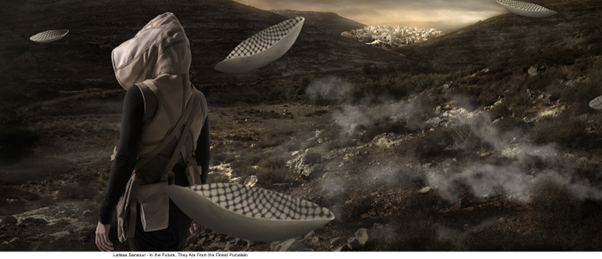
Filmmaker Larissa Sansour’s work is rooted in Palestinian agency. Her multi-disciplinary art centres around identity, memory and diaspora, challenging presentations of Palestinians as solely victims. Sansour’s 2016 film In the Future They Ate From the Finest Porcelain blends sci-fi, politics, and archaeology into a metaphor for Palestinian preservation of culture, exploring themes of national identity and the myth of history. In the film, a resistance group facing persecution buries porcelain plates to protect their identity from eradication. Sansour draws parallels to her own history, critiquing the idea that history is written by the victors. In one scene, a bomb falls beside a child. Instead of exploding, it cracks open to reveal the pristine porcelain plates - symbolising the Palestinian connection to their land.
For Sansour, art is not just a portrayal of her people’s suffering, but an insight into the preservation of culture under occupation, a decolonial act of resistance. Thanks to her other brave filmmakers, Palestinians are no longer just numbers on a news bulletin. Their stories live on in every frame.
Whilst Palestinian identity has been altered and irrecoverably changed by the Zionist occupation, it is not the only narrative. Sansour’s work reminds us to always see beyond the image of suffering victims. From Dabke to Darwish, Palestine, like the rest of the Global South, maintains a rich tapestry of culture and history, protected by generations of local communities.
The Missing Picture (2013) is Cambodian filmmaker Rithy Panh’s testimony of Cambodian existence under the Khmer Rouge regime. Panh documents the story of his stolen childhood using a combination of newsreel and documentary footage alongside clay figures which dramatise the genocide’s events and impact on the Cambodian community. From 1975 to 1979, over the course of three years and eight months, two million Cambodians - roughly 25% of the population - were killed by forced labour, starvation, disease, and execution. Inspired by his youth of clay making and ‘the idea that life can come back again through clay and water’, Panh criticises the West’s collective amnesia of Cambodian suffering.
These figures hold deep aesthetic and emotional weight: they represent holes in his memory, missing evidence of the crimes committed against his people, and also pay tribute to an ancient tradition of Cambodian pottery making dating back to Angkor Wat. By interweaving cultural tradition with the trauma of genocide, Panh refuses to let the world forget his people’s stolen youth.
US Filmmaker, Madeline Gavin’s City of Joy (2016) is no less harrowing. It tells the story of sexual violence survivors living in eastern DRC, where a child is raped every thirty minutes, according to the UNFPA. The film centres the Congolese narrative, documenting a school for survivors, where women can find treatment and education, filled with smiles, songs, and dance. A place where trauma and joy coexist.
In literature, the trope of the ‘suffering African woman’ has emerged after centuries of racism. City of Joy challenges this as the women transform suffering into power. Their joy comes from their desire to survive, and to reach this they must first accept the violence they have faced. The juxtaposition of visceral interviews recollecting sexual violence and torture, and the bright colours, group choral singing, and smiles of the Congolese women prove that the West’s portrayal could not be further from the truth. Instead, she suggests the Global South can heal itself when Western-backed militia and interventions are removed.
Congolese activist and founder, Christine Schuler Deschryver wants to revolutionise the mindset of Congolese women. She proclaims: ‘you will change the suffering you’ve endured into power.’ This statement reflects the agency her initiative gives its students, and this documentary allows survivors of sexual violence across the globe the chance to partake.
It is essential that these filmmakers are able to continue to disrupt the narrative of war. Otherwise we fall into a collective amnesia, where only those with the power are remembered. These films remind us that no life is worth more than another, in a time when asylum seekers face constant persecution, and millions live in the midst of war. They create a shared humanity we desperately need to face the future. Beyond documenting trauma, these films serve as a testimony to war crimes and human rights abuses, giving agency to the filmmakers and communities they represent. They are the foundations of a path towards healing and accountability. They are essential viewing for anyone seeking to understand decolonisation; for how can we ever understand a person’s struggle for liberation unless we’ve truly listened to their story.
Now, we must push for an expansion of Global South cinema, where stories of war belong to the communities who live them.