Colonialism, But Make It Fashion
Chandra Verma, Opinions Section Editor, BA Politics and International Relations
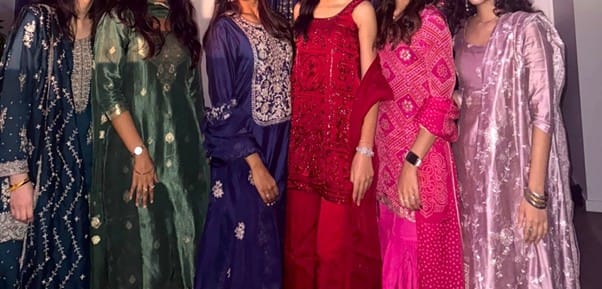
The first time I noticed an Indian dupatta advertised as a ‘Scandinavian scarf’ on Instagram, I believed it to be satire. The model was dressed in a light, embroidered cloth that was eerily similar to the one my mother wears on a typical day back home. However, this dupatta was now being sold for £80 and was referred to as ‘minimalist European design.’
Observers of South Asian and global fashion, such as ELLE India, have seen similar trends which has led to debates over cultural appropriation and fashion colonialism. The dupatta that I wear to every relative's wedding, that my friends and I used to play with as kids to copy our mother’s saris, and that I wore to school every day as part of my salwar-kameez uniform; it has been reinvented as a statement of Western fashion. The history of my people has once more been rewritten to fit Western demands. This idea of claiming what is not yours is a traditional colonial strategy that is now thriving in unconventional industries like fashion. Why does my culture only become appealing when it is repackaged, sold for hundreds of pounds, and given a new name?
I discovered more of it as I scrolled through fashion pages. Chappals that resembled those worn by Indian shopkeepers were now referred to as ‘artisan Prada sandals.’ The mirrored kurtas I used to see at local festivals have transformed into ‘boho festival wear.’ Bindis have been redesigned as ‘face jewels’ on Etsy. Each one gave a sense of discovery, as though someone was finding a long-lost gem, and not something that had existed for generations in our homes, festivals, and streets.
It's funny how things from my childhood only become beautiful when they are claimed by someone outside my culture.
This is merely another cycle of trends for Western brands. For us, however, it is a much more serious act of erasure. It is demeaning and wilfully ignorant when such items are presented as exotic curiosities upon being stripped of their roots. Vague terms like ‘artisan’ or ‘bohemian’ are used as a convenient cover story to sanitise the act of theft. Even the idea of ‘bohemian’ culture itself, an aesthetic based on borrowed identity and romanticised poverty, feels oddly colonial.
Chappals are the essence of the home. They are modest, commonplace, and essential. It is not only ridiculous to see them promoted as high-end shoes by a company like Prada, but it is also a manifestation of corporate greed posing as cultural appreciation. These aren't ‘new designs’. They are stolen.
Growing up in India, these outfits were never considered fashionable. They were intertwined with life itself. A dupatta was more than just an accessory. It represented femininity, culture, and at times power. Our chappals were functional rather than fashionable. However, I see them taken out of context in the West and transformed into fashion choices for individuals who will never know what it means to wear them in their original context. The irony that what is commonplace for us only becomes exceptional when viewed through a Western lens is draining.
What makes things worse is the silence. Indian design, Indian labour, and Indian workmanship are not acknowledged by these businesses. These items seem to have just appeared, devoid of hands, culture, or history. Colonialism never truly stopped; it only improved its branding. The same system that used to make fun of our clothing as ‘primitive’ now makes money off of its reinvention.
There also exists a personal discomfort to seeing my culture on someone else's body, labelled and misinterpreted. When I wear a dupatta in London, I am conscious that it may make me appear ‘too ethnic’ in certain places. I even hesitated to wear traditional clothes out at night for Diwali because I was worried of seeming too much like an immigrant, too noticeable, and too foreign. However, when a Western influencer wears the same clothing, it is considered ‘chic.’ The double standard is very hard to ignore. Without recognition, appreciation is still appropriation.
I do not feel that Indian culture should be protected from the world at large. However, it is deserving of a respectful and truthful name. A dupatta is not the same as a scarf. It carries with it a story passed down through generations of women who wore it with pride, defiance, and purpose.
While colonialism has changed its appearance, it is still the same empire, just with higher-end brands.