Embassies: The Contemporary Stage for International Politics
Sylvie Topps, LLB Law
A protest outside the Iranian embassy and a separate dispute over China’s proposed ‘mega-embassy’ in London may appear to have little in common. One was driven by anger over the killing of tens of thousands by the Islamic Republic of Iran, the other by concerns over national security and surveillance. Yet together they point to a wider pattern in modern Britain: embassies are focal points for political tension, viewed not only as diplomatic buildings but as symbols of state power that function as assemblies for opposition and public resistance.
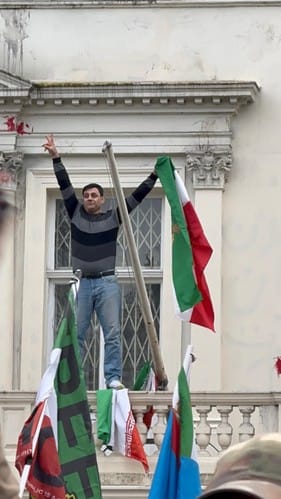
That symbolism was vividly displayed throughout January outside the Iranian embassy in Kensington, where hundreds of protestors gathered waving Iranian flags and chanting against the Islamic government. During the demonstration, one protester climbed across balconies to reach the embassy’s terrace and removed the flag of the Islamic Republic of Iran before being detained by police. In total, 14 people were arrested for offences including violent disorder, trespass on diplomatic premises, and assaulting emergency workers, while four people were taken to hospital. Police said objects were thrown at officers, several of whom sustained minor injuries, and a dispersal order was imposed following what the Metropolitan Police described as ‘ongoing disorder.’
The protests in London are part of a global wave of protests outside Iranian embassies, mirroring unrest that has erupted across multiple cities in Iran against the Islamic Republic and a deepening economic crisis. This has led to the largest uprising since the 1979 Islamic Revolution, with human rights groups reporting that thousands have been killed during the crackdown by Iranian security forces. As of January 25th, more than 36,500 Iranians have been killed by security forces during the crackdown on protests on January 8–9, marking the deadliest two-day massacre in history.
Iran’s Supreme Leader, Ayatollah Ali Khamenei, has dismissed protestors as ‘troublemakers’ acting in the interest of foreign powers, while an internet blackout has restricted reporting from inside the country. The UK, alongside France and Germany, has condemned the killing of protestors, and the Iranian ambassador to London was recently summoned to the Foreign Office.
For many protestors, the Iranian embassy represents far more than a diplomatic mission. It is viewed as a physical embodiment of a regime widely viewed as indicative of repression, censorship and mass violence. Many protestors have called for an end to the Islamic Republic, with some urging the restoration of the monarchy. Confronting the embassy through protests offers a way for diaspora and supportive communities to challenge a state that cannot be openly confronted in Iran. As such, embassies become stages where distant political struggles are enacted locally.
A different set of tensions has surrounded the government’s decision to approve China’s plans to build the largest embassy in Europe in central London, eight years after Beijing bought the site. The development, which will see the consolidation of Chinese diplomatic ties into a single 20,000 square metre site at Royal Mint Court, was approved by Housing Minister Steve Reed on January 20th despite opposition from Parliament and local residents.
Pro-democracy campaigners from Hong Kong as well as British and American politicians have warned the government against allowing China to build the embassy on the site over suggestions that it could be used as a base for spying. Critics argue that it represents not just a practical diplomatic facility, but a projection of Chinese state power at a time of strained relations with the West. This opposition was expressed by Conservative Party leader Kemi Badenoch, addressing protestors at the site stating, ‘We do not want a country that spies on our MPs having this super-embassy right here.’ The £255 million site is close to fibre optic cables, leading to concerns they could be used by China to access vast amounts of highly sensitive data. This is especially contentious within Parliament as the British embassy in Beijing continues to await planning permission from the Chinese government for a £100 million renovation. Moreover, the embassy continues to be threatened by significant legal challenges as residents have said they plan to dispute the approval in the courts.
Nonetheless, Steve Reed has dismissed a successful court challenge, stating that the planning decision is now final. Moreover, no official responsible for national security has raised concerns or objected to the proposal on the grounds of its proximity to the cables. This has been reinforced by Security Minister Dan Jarvis, who said that China would continue to pose national security threats but added that after ‘detailed consideration of all possible risks around this new embassy … I am assured that the UK’s national security is protected.’
The controversies surrounding the new Chinese ‘mega-embassy’ reflect wider fears over the blurring of boundaries between diplomacy, government intelligence, and state coercion. The prompted parliamentary debate, legal challenges, and interventions from security ministers demonstrates how embassies are now viewed through the lens of national security as much as international relations.
These cases sit within a broader global context characterised by shifting geopolitical alignments, increased strategic competition between states, and growing attention to the activities of governments. This has inevitably prompted closer scrutiny of how diplomatic infrastructure operates beyond its traditional representative role, as embassies are key political pressure points, where expressions of opposition, public concern, and international tension become salient.