Fashion as Political Theatre: Why We Fixate on What Women Wear
By Siddhant Pawar, BSc Politics, Philosophy and Economics
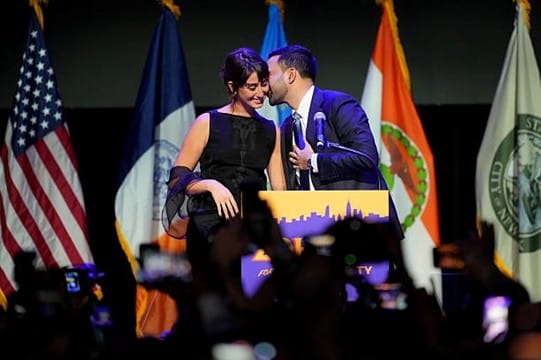
When New York City swore in its first Muslim Southeast Asian mayor, the world paid attention. His wife Rama Duwaji, a Syrian illustrator and animator based in New York, shared the spotlight. She joined her husband on stage wearing an embroidered top by London-based Palestinian artist Zeid Hijazi, and within minutes, her victory-speech look took the internet by storm. For some, this was fashion activism; for others, it was just an opportunity to criticise a woman for her clothing.
Fashion has quietly turned into one of the most charged forms of political theatre. Where clothes aren’t just clothes anymore, but they signal allegiance, identity, and sometimes resistance, and when it comes to women, this symbolism takes centre stage. Many people celebrated Duwaji’s choice as an act of self-expression. In an age where protests are censored and outspoken voices are suppressed, subtle cues have stepped in to echo the voice of dissent.
Fashion activism is certainly not a new phenomenon. During the French Revolution, working-class men called themselves ‘sans-culottes.’ The term highlighted their low-class status, because they wore long trousers instead of the aristocratic breeches.
Their trousers became a political declaration, a proof of belonging to a movement. But the coverage of Duwaji unfolded a completely different narrative. Alongside the praise came the usual backlash. Was it too political? Not political enough? A strategic move? An aesthetic choice? Women rarely get to wear anything without someone demanding an explanation. Even when fashion isn’t politically driven, it’s read as a message.
This highlights how fixation has become more obvious. Fashion is often treated as a product of consumerism. However, for women, certain clothes are perceived as markers of taste, class, morality, and social belonging. Even First Ladies are expected to dress the part, with the ‘pillbox hats and boucle suits’ being the classics of this genre as described by Vogue; a carefully curated superficial elegance. In that world, Duwaji stands out. She isn’t playing by the script, and that alone unsettles people.
Sociologist Pierre Bourdieu helps us make sense of this: cultural capital refers to the habits and styles that society rewards, and social capital refers to the networks and recognition that those styles provide access to. When women dress, the world rushes to decide whether they ‘fit’ the ideal and whether they deserve approval, suspicion, praise, or discipline.
So a Palestinian-designed top isn't just a piece of cloth. It gets burdened with meanings about identity, loyalty, femininity, and politics. Women’s clothing becomes a symbolic terrain where hopes, fears, and prejudices are exposed. Women also have historically been treated as bearers of family honour and culture. Hence, what they wear is always judged before it's even seen.
Fashion can be resistance, but it can also be a weapon used against women. Clothing lets women speak in moments when speaking is punished, and this brings them to scrutiny that men in the same spaces rarely face.
As long as clothes are wielded as both armour and target, fashion will remain political theatre, and women will continue to pay the cost of the performance.