Ferrari's Downfall
Kaitlyn Prince, Photographer, BA Politics and International Relations
Ferrari entered Formula One’s 75th season with real optimism, hoping to revive the legendary Scuderia legacy. With steadier leadership, a strategic upgrade strategy, and the hype of their unstoppable driver line-up, Charles Leclerc and seven-time world champion Lewis Hamilton, the year promised to be a turning point for the team. However, the double DNF (‘did not finish’) at the São Paulo Grand Prix has become the clearest sign of their collapse.
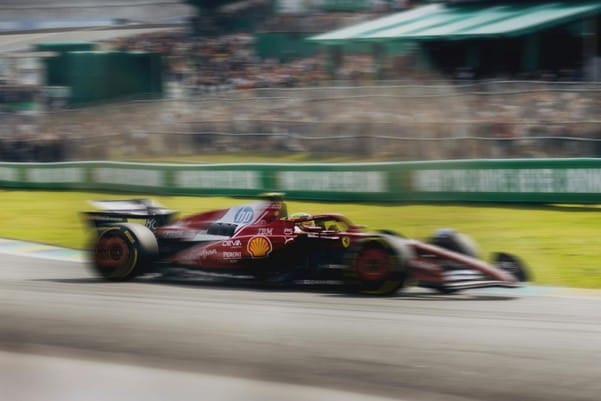
A range of factors has contributed to Ferrari’s disastrous season, starting with persistent technical failures. Leclerc admitted that the tight margins during qualifying in Brazil masked the reality of Ferrari’s struggles as they lacked true race pace. Hamilton’s race on Sunday further exposed the instability of the Ferrari SF-25: early contact resulted in a broken front wing and heavy floor damage, causing a loss of downforce and making the car almost undrivable. After serving a time penalty for the early contact, it seemed impossible for his race to recover, and Ferrari decided to retire the car on lap 39 to avoid further damage. Leclerc’s race ended even sooner, taken out on lap six after being hit by Antonelli. Despite the situations being out of the drivers’ control, as a result, Ferrari chairman John Elkann publicly criticised both drivers, effectively throwing them under the bus, saying they should ‘focus on driving and talk less,’ a comment demonstrating the internal tension within the team.
Brazil was not the only weekend that highlighted the Ferrari struggle. Both Ferraris failed to finish at the Dutch GP as well: Hamilton spun in damp conditions and Leclerc once again collided with Antonelli. Team principal, Fred Vasseur, called it ‘a very tough outcome,’ the weekend ending with zero points. These repeated DNFs go beyond just bad luck, exposing deeper structural fragility inside the team.
Ferrari is suffering the consequences of huge blows to their Constructors’ Championship fight, dropping from second place to fourth place in the standings following the second DNF of the season in São Paulo. Hamilton has openly described his first year with the team as a ‘nightmare,’ admitting that the contrast between his long-held dream of driving for Ferrari and the reality of their troubled results has been difficult to process. Despite the setbacks, he says he is trying to keep his head above water and remain positive. Criticism from leadership does nothing but damage morale and public confidence in an already shaky Ferrari.
Scuderia Ferrari, the oldest surviving and most successful Formula One team (competing in every world championship since 1950), is undeniably iconic, and full of potential. But the team lacks stability and strategic consistency. This problem is not new: a series of major strategic errors cost Charles Leclerc what seemed like an assured victory in his home race, during the 2022 Monaco GP. Unless Ferrari identifies and confronts the root of these recurring failures, the season risks unravelling even further.
Still, there is a sign of some hope. Jenson Button, the 2009 F1 world champion and former teammate to Lewis Hamilton, claims that Ferrari are still close enough to the Constructors’ Championship to fight back. While perhaps, by delivering a few strong results, they could still finish third; the broader pattern points to deeper issues within the team - a downfall that is clearly not accidental.