How Gaza’s Ruins Became Trump’s Development Project
Salsabeel Yasir, BA History and International Relations
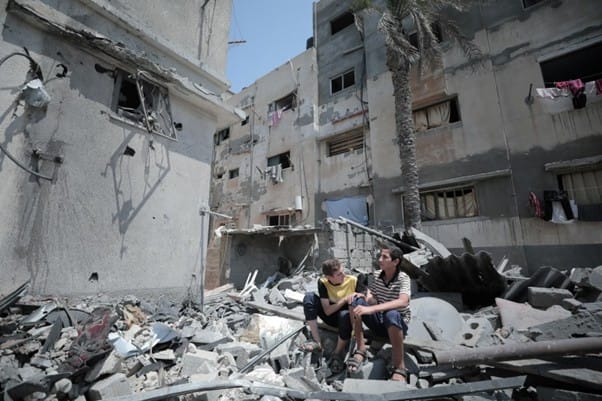
While Gaza faces mass starvation, continued bombardment, and constant displacement despite a supposed ceasefire, a neo-colonial governing structure has emerged to oversee its ‘reconstruction.’ This has been designed by many of the same Western political and corporate elites who denied or downplayed Israel’s genocide in Gaza, now that destruction has made reconstruction profitable.
The Gaza Board of Peace was officially launched in Davos, Switzerland, at the World Economic Forum, a week after Trump’s Special Envoy Steve Witkoff announced ‘Phase Two’ of the Gaza ceasefire plan. Framed as an international authority to administer Gaza’s recovery, the board represents a continuation of Western intervention, this time under the language of peace and development.
Jared Kushner, Trump’s son-in-law and former senior adviser, outlined the board’s vision for Gaza’s future, showcasing plans for high-rise developments to be built over an estimated 60 million tonnes of rubble, debris that includes the bodies of tens of thousands of Palestinians and unmarked mass graves. At least 50 to 60 countries have reportedly been invited to join the board, with up to 25 accepting so far. Permanent membership of the board is tied to a $1 billion contribution, commodifying Gaza’s reconstruction while Palestinians continue to be murdered and displaced.
According to its charter, the board grants Donald Trump, as chairman, extensive executive powers, including veto authority and the ability to remove members. While presented as multilateral, real power lies with its executive board which controls funding, priorities, and governance frameworks, administering Gaza from above while relegating Palestinians to administrative roles within a technocratic committee.
Several European states, including France, Denmark, Norway, Sweden, and Slovenia, have declined to join. The United Kingdom (UK) has yet to confirm its participation, citing concerns about Russian involvement amid the war in Ukraine.
A deeper concern shared by several European governments is that the Board of Peace risks functioning as a private rival to the United Nations: a Trump-led enterprise reshaping global governance in his image.
What is being presented as peace and reconstruction is better understood as a neo-mandate: an externally imposed system of control that treats Gaza’s devastation as an opportunity for profiteering.
This logic is reflected in the composition of the board’s executive leadership, announced on 16 January. It is stacked with figures whose political careers have been defined by imperial intervention, corporate governance, and unwavering support for Israel’s military campaign. Members include Tony Blair— dubbed by critics the ‘butcher of Iraq’ for his role alongside the United States (US) in the 2003 invasion— and Jared Kushner, who has repeatedly minimised Palestinian suffering while defending Israel’s genocide in Gaza. Marco Rubio, a vocal opponent of the BDS movement and a long-standing advocate of unconditional US military support for Israel, also sits on the board, as does Steve Witkoff, who has tied Gaza’s reconstruction to Hamas disarmament while working closely with Israeli leadership on post-war frameworks.
Alongside these political figures are corporate and financial elites. The inclusion of figures, such as billionaire investor Marc Rowan and World Bank president Ajay Banga, signals that Gaza’s future is being approached less as a humanitarian question than as a development project.
The structure of the Board of Peace reflects a broader capitalist logic in which destruction creates opportunity. Mass displacement and widespread death are not treated as political crimes requiring accountability, but as conditions that make reconstruction governable and profitable. Membership is secured through financial contribution, governance is tied to investment, and Palestinians are excluded from meaningful decision-making.
Only once Gaza has been reduced to rubble does Western interest in its future become urgent. The Board of Peace reflects a familiar imperial logic: destroy, administer, extract, and govern from afar, treating Palestinian life as disposable, and Palestinian land as capital.