‘I’ll Have Greenland Next’ Trump and the Not-So-New Age of American Intervention
Ayah Abu Mraheel, BA History and Politics
It seems Donald Trump’s new year's resolution for 2026 is expansionism.
Three days into the new year, Operation Absolute Resolve saw the United States (US) carry out a military operation in Venezuela that resulted in the capture and removal of President Nicolás Maduro. For months, a team of US intelligence officers monitored Maduro’s movements, carrying out meticulous rehearsals that reportedly included the construction of a life-size replica of his Caracas home. Congress was deliberately excluded from the operation, underscoring the administration’s ongoing disregard for constitutional oversight. The raid itself, conducted while Trump watched remotely from Mar‑a‑Lago, flanked by loyal advisers, was later celebrated by the President who likened it to the spectacle of ‘watching a television show.’
The Trump administration outlined the operation as a combined law-enforcement and security action, linked to longstanding US accusations against Maduro involving narcotics trafficking and corruption. Speaking shortly after, Trump said the US would assume temporary control of Venezuela’s administration to oversee what he described as a ‘safe, proper and judicious transition’ of power. He also indicated that US oil companies would play a role in restoring Venezuela’s energy and oil infrastructure.
Within days, Trump’s attention had shifted once again, this time back to Greenland— a fixation he has nursed since 2019 when he first enquired if he could purchase the territory. Danish Prime Minister Mette Frederiksen dismissed the idea as ‘absurd,’ and Trump reacted by cancelling a state visit and calling her ‘nasty.’
However, in January 2025, Trump rekindled his desire for Greenland, with the ‘Make Greenland Great Again Act’ drafted by House Republicans. This authorised the president to negotiate a purchase. A year later, he is adamant to see this deal through. In a crisis meeting with Danish and Greenlandic officials, Trump is quoted to have said he would obtain Greenland ‘whether they like it or not’ and vowed that if ‘we don’t do it the easy way, we’re going to do it the hard way.’
Trump’s insistence on ownership sits uneasily with the reality that the US already enjoys extensive military access to Greenland. Under a 1951 defence agreement with Denmark, Washington operates the Pituffik Space Base and retains broad rights to expand its presence on the island, arrangements that have long made Greenland a central component of US Arctic and missile-defence strategy. Yet, Trump has dismissed such agreements as inadequate. Speaking in interviews and press encounters, he argued that leases and treaties fall short of what he considers real security. ‘Really it is, to me, it’s ownership,’ he said, describing ownership as ‘psychologically needed for success,’ and warning that without it, Greenland would inevitably fall to ‘Russia or China.’ Greenland holds significant deposits of rare earth elements and critical minerals, increasingly accessible as melting ice makes extraction commercially viable.
It seems Trump's first line of defence against international condemnation is, as per usual, economic threats. On January 17th, he claimed he would impose 10% import tariffs on goods from Norway, Sweden, France, Germany, the Netherlands, Finland, and Great Britain starting February 1st and increasing to 25% by June until the US is able to purchase Greenland, stating that these countries were playing a ‘dangerous game.’
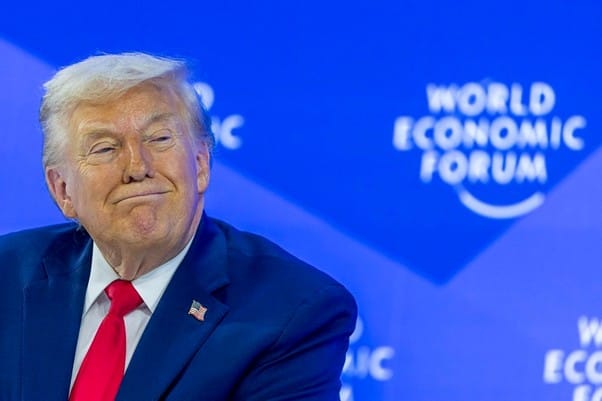
The American Secretary of Commerce, Howard Lutnick, attempted to pull on the heartstrings of his fellow financial advisors at the World Economic Forum in Davos last week, prompting them to imagine how ‘dark’ a world without the US’ financial support would be. They were largely unconcerned.
The language circulating at the summit made one point unmistakably clear: Western governments had no intention of yielding on the issue. Take, for instance, the Prime Minister of Canada, Mark Carney’s warning that ‘we are in the midst of a rupture, not a transition,’ Ursula von der Leyen’s description of a ‘Rubicon’ being crossed, and the Belgian Prime Minister Bart De Wever’s insistence that ‘so many red lines are being crossed that you have the choice between your self-respect or being a miserable slave.’
Trump's zeal for Greenland has done what decades of war in the Global South could not: made the West suddenly discover the sanctity of sovereignty.
Emmanuel Macron’s text messages leaked by Trump on Truth Social expose the matter quite clearly:
‘My friend, we are totally in line on Syria. We can do great things on Iran. I do not understand what you are doing on Greenland.’
The Gaza Peace Board, the fact that the US continues to exercise control over five permanently inhabited territories, the invasion of Iraq two decades ago, and Macron’s assurance that he agrees with intervention in Iran and Syria all point to the same reality. What is being treated as unacceptable now is not the act of intervention itself, but the identity of the place in question. As Kehinde Andrews has observed, ‘if it was a Black or brown place, it would have happened already.’
With Keir Starmer and Mark Carney having travelled to China in January to wean their countries off Trump’s unrestrained imperial overreach, we see a pivot to Xi’s China.
As unprecedented as Europe casting aside its dependency on US support may be, it brings to light the placement of the ‘red line’ Trump has crossed; it is cartographic.