
‘Immigrants Are Taking Our Jobs’
Maaryah Rashid, Co-Deputy Editor, BA Politics and International Relations
We have another epidemic on our hands, except this time, it’s not an attack on the immune system. A significant portion of the UK population has unfortunately adopted the xenophobic and harmful ideologies of the radical far right, championed by public figures such as Tommy Robinson and politicians like Nigel Farage, otherwise known as the primary carriers of this fatal disease.
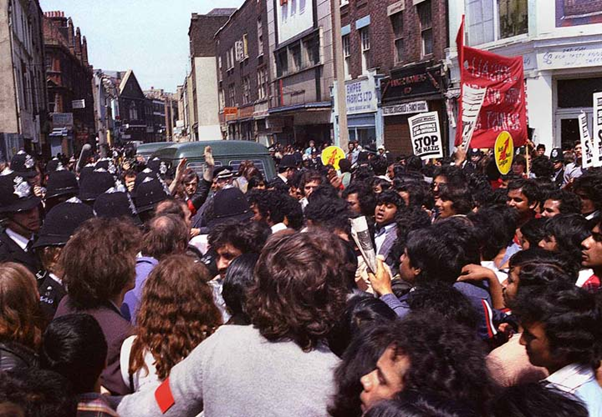
Reform UK, the successor to the Brexit Party and led by Farage, largely focuses its messaging on reducing or ‘freezing’ immigration, withdrawing from the European Convention on Human Rights to control borders, and promoting the idea that immigration threatens British jobs and public services. These views have been criticised by groups such as ‘Hope Not Hate’ and ‘Stand Up to Racism’, who argue that this messaging dangerously fuels xenophobia and ignites hostility towards minority communities.
Evidence of this growing hostility can be seen through the rise of racially motivated hate crimes committed against minority communities. As of 2025, racially motivated hate crimes in the UK have risen by 6%, with over 82,000 recorded offences, rendering them the most common form of hate crime. A horrifying example that comes to mind is the brutal attack on a British Sikh woman that occurred in the West Midlands earlier this year. The young woman, who is in her 20s, was reported to have been attacked on her way to work by two white men and then raped. During the attack, one of the men told her ‘You don’t belong in this country, get out.’
Immigrants and ethnic minorities are being vilified and dehumanised, yet their reality within British society tells a very different story.
South Asian immigrants and their descendants are undeniably central to the UK’s success. Contrary to the far-right assumption that they are simply a drain on resources, they drive the economy and healthcare system through hard work, resilience, and ambition: values rooted in the sacrifices of their parents and grandparents.
To understand this better, I spoke with two second-generation British Bangladeshis: Tasneem, a successful author and mother, and Yasmin, a teacher and also mother. They reflected on how being raised by immigrant parents shaped their values, work ethic, and parenting values, providing an insightful understanding of the roots of the valuable South Asian contribution to British society.
Tasneem spoke about the discipline and sacrifices of her father, who emigrated from Bangladesh to provide for his family:
‘My dad was very disciplined- everything according to routine, and he worked very hard because he sacrificed a lot to come here and provide for his family in Bangladesh. He tried hard to instil this in his children and was disappointed it did not land with everyone.’
She described the pressure to live up to the achievements of relatives back home, noting:
‘My relatives back in Bangladesh were high achievers and we were constantly compared to them. They are all engineers and doctors, and my dad had the same expectations.
Tasneem explained that this upbringing fostered a strong sense of gratitude and awareness of inequality:
‘We kind of grew up knowing we were very lucky to be here. We grew up on stories of how they would walk miles and miles to get to school. He would study in the landing because there was no place to study and to make the most out of all the opportunities.’
She also reflected on systemic disparity: ‘I am very aware of the disparity between, say, white people and non-white people here. I think people of colour have been statistically proven to work five times harder than their white counterparts to get to the same level.’
When I asked how this impacted her own parenting, she expressed:
‘I work hard to try and get my kids to take education seriously in order to even out that playing field a little bit. Because I know for them to be successful, they have to work even harder.’
Tasneem also recognised the comparative advantage her upbringing provided in practicality and resilience:
‘The ones who didn’t have immigrant parents seemed to take things a lot more for granted because everything came so much easier for them… Our parents had to be practical because they had to work so hard to survive in an alien land that didn’t accept them.’
While Yasmin did not face the same intense pressure to overachieve academically as Tasneem, she still navigated expectations from both her parents and her peer group:
‘If you weren’t doing science, then you were considered a bit of an outcast. In terms of education, they wanted us to do our best, but I do feel like I had a more ‘western’ upbringing in the sense that there wasn’t a pressure to get, like, A’s. It was more like, okay, try your best, see how it goes.’
Even without the extreme pressure, Yasmin still followed the traditional South Asian path:
‘I went down the traditional route, I did all the sciences, I didn’t get into medicine, but it wasn’t like that was the end of my life. I still went down the science route, so my parents were still happy.’
She also highlighted the subtle but persistent pressures from friendship groups and the broader South Asian community:
‘There was still an external pressure within my friendship groups. All my friends had immigrant parents, and again, it was that same ethos where you have to work hard, you have to try and get high grades. For Western Europeans, they take it as it’s happening; but for us, it’s more about the future, and how we’re gonna get there with as few obstacles as possible because our name and our looks are already an obstacle.’
The resilience and dedication highlighted by Tasneem and Yasmin are far from isolated experiences. They are reflected across the South Asian community in the UK, and the results of this dedication are evident in the South Asian contribution to the economic and healthcare sectors in the UK, reinforcing the impact of their work ethic.
South Asians make up just 7.5% of England and Wales’ population, according to the 2021 Census, yet they account for an estimated 25-30% of NHS doctors and around 14% of general practitioners. This remarkable overrepresentation is also rooted in history. Between the 1950s and 1970s, more specifically after the genesis of the NHS in 1948, thousands of doctors from India, Pakistan, and Bangladesh came to the UK to fill critical shortages after the Second World War. By the mid-1960s, nearly a third of new NHS doctors had trained overseas, most of them from South Asia. Their contribution didn’t just sustain the NHS in its early years; it helped it survive and thrive.
The British economy has also greatly benefited from South Asian entrepreneurship. Indian-owned companies alone generated £72 billion in revenue in 2025, employing more than 118,000 people and paying over £1 billion in corporation tax. Across England, Asian-owned businesses account for roughly 6% of all Small and Medium-Sized Enterprises (SMEs), contributing to an estimated £25 billion annually to the British economy. They represent about 14% of all businesses in London, supporting around 300,000 jobs, ultimately strengthening local economies and creating employment.
The far-right’s anti-immigration narrative collapses under the weight of these facts. South Asians and other immigrant communities don’t weaken Britain; they strengthen it; they keep it moving. The only threat to Britain's wellbeing is the spread of hatred and ignorance of the immigrant identity and its contribution to society, resulting in the division of the nation against itself.