Imperial Amnesia on Remembrance Day
Salsabeel Yasir, BA History and International Relations
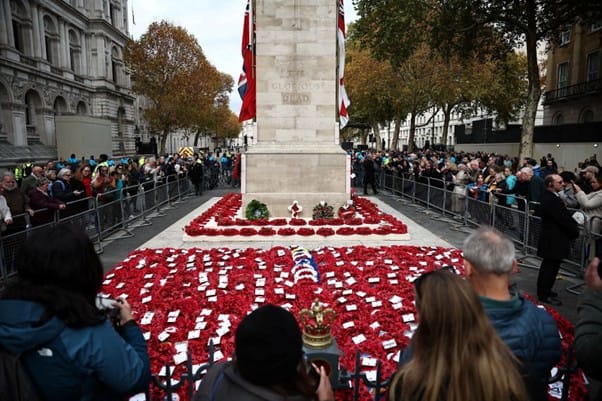
Every November, as Remembrance Day approaches, debates over the red poppy resurface. As poppies appear on lapels, so do controversies surrounding them. These criticisms have inspired the rise of the alternative white poppy, created by a pacifist movement to remember all victims of war, across nations. While these critiques are valid, and the white poppy addresses some of them, neither the red nor white poppy, nor most public discourse, confronts a more fundamental question about World War I (WWI): What was the war actually fought for? What did the soldiers and civilians we honour die for?
WWI was not fought for ‘freedom and democracy’; it was fought to protect and expand the Empire. Remembrance offers a simplified story of noble sacrifice, and the poppy has become a symbol that detaches the war from its political purpose.
In 1914, Britain joined the war after Germany invaded Belgium, citing a legal obligation to uphold Belgian neutrality. However, this was a convenient public justification rather than real motivation. The government was more focused on protecting imperial trade routes and naval supremacy in the face of Germany’s rapid military, naval, and colonial expansion. Had Germany defeated France and controlled the Channel coast, Britain’s empire would have been jeopardised, making it clear from the outset that Britain’s real motive in entering the war was to protect imperial interests, not to defend freedom.
Britain’s priorities during the war make it abundantly clear that its main concern was preserving imperial dominance. By declaring Egypt a protectorate and deploying troops to defend it, securing the Suez Canal became an early priority since it offered the shortest sea route to colonies and protectorates, essential for transporting resources from the Empire to Europe.
Millions of colonial subjects were made to fight and die in a war unrelated to their interests to preserve the Empire that governed and oppressed them. Over 1.3 million Indian soldiers were sent to fight on the frontlines, alongside recruited troops, often coercively, from African colonies. While recent Remembrance has tried to honour colonial soldiers, their contributions are usually acknowledged symbolically, and are rarely framed as imperial exploitation.
If WWI had truly been about ‘freedom and democracy,’ the British Empire would have shrunk. Instead, it emerged at the peak of its imperial power, ruling a quarter of the world’s land and nearly 458 million people. Britain and France’s division of the Ottoman Empire under the Sykes-Picot Agreement in 1916 led to the creation of mandates in Palestine, Iraq, and Transjordan. These are effectively colonies, their borders and governance deliberately engineered for economic and imperial exploitation. Their legacies still shape the region today, especially in Palestine, where the British administration laid the foundation for the Israeli settler-colonial state. Without recognising WWI’s imperial legacy, we cannot understand how British policy continues to shape the region.
We say ‘lest we forget’, yet forgetting is built into Remembrance: forgetting empire, colonialism, and the millions who suffered under British rule. This is not an attack on individual soldiers, many of whom believed they were fighting for noble reasons or were forced into a war they did not comprehend; It is a critique of empire and its aims. Remembrance honours the dead but refuses to acknowledge the imperial project they died for.