Is The West 'Turning' Chinese?
"Until very recently, China was seen as the enemy of Western society. How has this flipped so fast?"
Written by, Joe Barnes, MSc Environment, Politics and Development
Happy, belated, Chinese New Year! Is this a very Chinese time of your life? As we head into the new lunar year, China is yet again dominating the internet, news headlines, and my thoughts. Everyone is ‘china-maxxing’: stretching like a Chinese Grandma, doing gua sha, chain-smoking Chinese cigarettes, adopting Chinese medicinal practices, learning how to speak Chinese, and literally manifesting becoming Chinese. It’s everywhere online, with adverts from an e-sim company depicting ‘how to become a Chinese baddie 101’ and influencers ‘diagnosing’ themselves as Chinese. Is it simply a meme, or does this phenomenon represent something deeper?
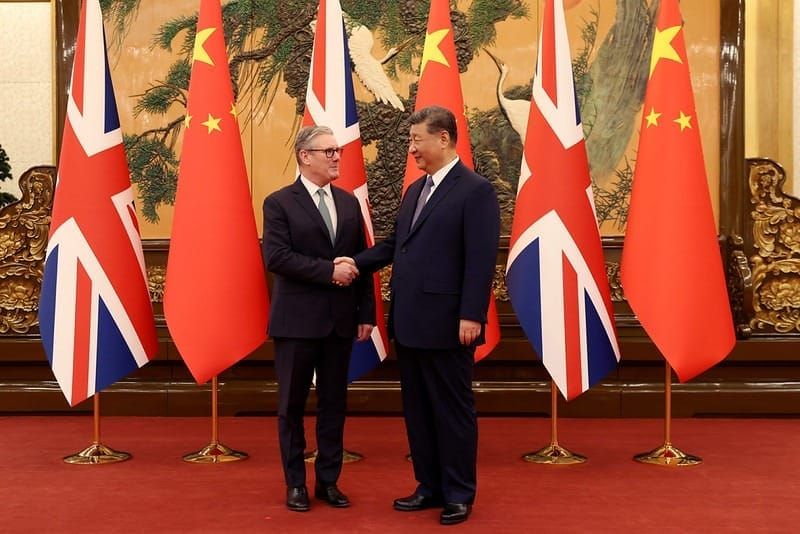
There has been discussion whether or not these changing cultural perceptions of China could be related to shifting geopolitics. A scroll on TikTok may have you thinking you’re Chinese, but is it a coincidence that simultaneously Keir Starmer visited China, being the first British Prime Minister to do so in 8 years? Or that last week, China granted UK citizens visa-free entry? Meanwhile, Mark Carney, the Canadian Prime Minister, is building a ‘new strategic partnership’ with China after only one year ago declaring it to be Canada’s ‘biggest security threat’. Until very recently, China was seen as the enemy of Western society. How has this flipped so fast? The world seems to be changing before our eyes at an ever-increasing rate of speed, but the switch in attitude towards China feels momentous.
China has long been represented as an existential threat to Western civilisation; from depictions of the ‘Yellow Peril’ in the late 19th century to a stark rise in Sinophobia due to the Covid pandemic. These depictions of China are not only xenophobic but often serve deeper, political, and perhaps less obvious functions. Successive American presidential administrations have described China as authoritarian ‘thugs’ alongside most Western leaders presenting China as a threat to democratic society. Often utilised as a strategy in electoral campaigns, it has been important to criticise China as a means to legitimise the ‘Western liberal democracy’ and to limit China’s influence. Edward Said’s 1978 book ‘Orientalism’ describes how the Western world depicts Asia as ‘lesser’ and ‘backwards’ in order to justify colonialism and the West as a ‘superior’ – and more advanced culture. This has often been done through media coverage focusing on China’s human rights abuses whilst failing to document its achievements. America: ‘the Land of the Free’; China: authoritarian repressive regime. This depiction is crucial in legitimising the neoliberal order of rule, and it has held strong for many years. In part, because of ‘Orientalist’ perceptions, deep-rooted colonial understandings of the world and media representations, but also because material conditions reflected this narrative with higher standards of living in the West.
However, as Kaiser Kuo has pointed out, we have seen a ‘Great Reckoning’ in the past few months. As Trump continues to smash the rules-based international order to pieces, standards of living are falling and the future looks bleak. As Marx’s Historical Materialism suggests, ideology is not made in a vacuum but is shaped by our material reality and as such, decreasing living conditions are leading to decreasing legitimacy for the West. The values that are celebrated as core tenets of Western civilisation are crumbling like styrofoam, as America relinquishes its role as the ‘world’s policeman’ and instead throws off its cloak to reveal its true imperialist nature without even an attempt at justification. Therefore, the moral panic that China is evil because it lacks freedom or privacy becomes silly when the US blatantly and without guise engages in such hypocrisy. Through the representation of China as the antithesis of Western society, it also becomes the antidote and solution to its shortcomings. People in the West are beginning to realise that perhaps Western liberal democracy is not the eternal, inevitable and liberating project that Fukuyama suggested would bring about the ‘End of History’.
Alongside geopolitical events and changing material conditions, cultural events have also played an important role in bringing about a switch in public opinion. HasanAbi and IShowSpeed’s trips to China, documented via livestream, helped to reveal what life in China is, praising Chinese infrastructure, EVs, high-speed rail etc. HasanAbi left China declaring, ‘in my heart, in my soul, in my mind, in my conscience, I have already become Chinese.’ Many commentators, however, cite the banning of TikTok as a definitive moment. This event perfectly encapsulates the interconnected relationship between geopolitics and culture. The US banned TikTok in an effort to limit Chinese influence over American citizens, citing security concerns that ByteDance would be forced to share data on the 170 million American users on the platform with the Chinese government. However, in doing so, many Americans turned to another Chinese social media platform in protest: RedNote. This allowed for rare proximity and an insight for many into the daily lives of Chinese people, and things didn’t seem so bad. In fact, it seemed perhaps even better than America, with successful large scale infrastructure and affordable standards of living. Then, the façade of Western superiority collapses.
The act of banning TikTok inadvertently pushing Americans to RedNote is somewhat metaphorical of the bigger picture: the instability of the Trump administration, with its disdain for international law and affliction with tariffs, has pushed Western countries into building a stable relationship with China. It is for this reason that the shift in popular consciousness has coincided and legitimised a reformulation of Western diplomacy towards China. Similarly, China’s industrial strategy has positioned it perfectly, with its prints over all sorts of important products from lithium batteries to iPhones to solar panels to Labubus. Production in China had once been tacky; now it seems almost inevitable, and so trade relations become increasingly important as the US becomes an unreliable ally.
However, when it comes to China, the picture is never quite so clear. There are elements of Western depictions of China that are xenophobic and racist, and there needs to be a wider re-evaluation of deeply entrenched colonial ‘Orientalism’, with a challenge to the perceived superiority of Western society and neoliberalism. However, being anti-West does not necessarily mean to be pro-China, and China has committed various human rights abuses: the repression of Uyghurs, alleged mass forced abortion and sterilisation campaigns, and state-enforced violence. These criticisms, however, should not be weaponised by Western nations with no cleaner histories as a means to legitimise imperialism. The scale of the moral panic that has surrounded China begins to seem unjustifiable. China has achieved many successes, which often fail to be represented by Western-dominated media; but we cannot also ignore the atrocities it has played a hand in committing. The reckoning with China must be a nuanced one.
The same applies to recent trends and cultural representations of China. To avoid falling into what writer Patrick Kho describes as ‘Orientalism Chic’ and cultural appropriation, the lived experiences of Chinese people cannot be flattened into nicely digestible consumption habits. This risks the perpetuation of the ‘other’, limiting the potential for a real reconciliation. Whether we are all Chinese now or not, it's probably time we thought about how we feel about China. Not as the idealised utopia, nor as the spectre of societal collapse.