
It’s Not All Reform: The Illusion of Domination in a Time of Plurality
Luc Cadwaladr-Evans, BA International Relations and Languages and Cultures
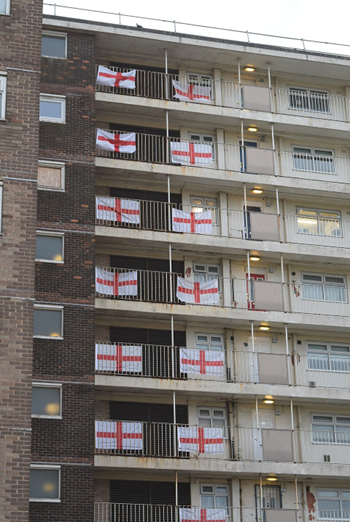
We’re often told that, as a result of its skyrocketing into the number one spot in UK party opinion polls, Reform UK has recently and unprecedentedly become the most likely contender to win a general election, if it maintains its current standing. While it is true that Reform comfortably takes the crown for Britain’s most popular party, we all know that for a party to win a general election, they have to hold a majority of Members of Parliament elected to government. Why, then, does the political Left in this country already seem defeated by a party that touts a meagre 27% in the most recent voting intention polling? In fact, totting up the numbers, we see that major parties perceived by the British public as being generally ‘left wing’ collectively accumulate a majority of the country’s voting intention. Although fragmentation appears to be the unending bane of left-wing electoral success, there’s more to the story than impending far-right domination. Just as two men with a ladder can hang 100 Union Jack Flags, 27% in the polls can inflate itself to seem an unstoppable political movement, given enough hot air.
Not convinced that Reform’s prospective success has been embellished? Scepticism is warranted. In the last general election, Labour scooped up its current super-majority with just shy of 38% of the votes; it is hard to say how Reform’s polling might translate to balloted results. Nevertheless, the early signs of Reform’s success being over-projected and under-delivered are there for all to see.
Let’s take a look at Caerphilly, the Welsh town that Nigel Farage had his eyes on as the next big win for his party. Polling showed a tight race, with Reform expected to narrowly snatch the Labour stronghold as the first of many Senedd seats likely to flip next year. Yet a predicted 42% manifested into a disappointing 36% for Reform, and Plaid Cymru’s Lindsay Whittle won with a comfortable 11-point lead. This scene, as a microcosm of the upcoming Senedd election next May, is a letdown for Reform at best; but the full picture is far bleaker for these budding Senedd hopefuls. With the Welsh parliament set to scrap First-Past-The-Post voting in favour of proportional representation for the upcoming election, we can consider the wider breakdown of the Caerphilly results to gain a clearer picture of what awaits Reform in May. 61% of ballots went to major left-leaning parties, with Reform on the right, accompanied only by the Conservatives, who received a 2% share of the vote.
Nigel Farage has been setting his sights on the 2026 Senedd election as the big opportunity his party needs to demonstrate their universality, to show how they were unjustly disadvantaged by the last election’s structure, and obtain their first tangible political power. But a lack of a majority on any side and a distinct absence of significant allies makes it seem unlikely that Reform’s Senedd aspirations will come to fruition. This has been further exacerbated by the recent suspension of the party’s only current Member of the Senedd, Laura Anne Jones, for the use of a racist slur and the encouragement of hate speech among her team.
Ironic as it may be, one of Reform UK’s biggest grievances in the aftermath of the last general election, the undemocratic nature of First-Past-The-Post voting, may be its last hope at securing government this time around. Now that Farage has the flavour of popularity, his pleas for proportional representation may cease. However, this does not mean that big changes aren’t still coming.
The media still largely portrays British electoral politics through what is an increasingly antiquated two-party framework, whereby whichever party is most popular, regardless of their actual share of approval, is seen as destined for government. To give credit where it is due, this greatly understates the impact that Reform’s asteroid has had on the Labour and Tory dinosaurs who for so long have oscillated in the House of Commons. But just because they brought about this change to the status quo, it does not necessarily mean that the Reform Party will be the sole beneficiary of it. If at any point the media picks up on this, the smoke will dissipate, and the mirrors will fall as the wonderful Wizard of Clacton is revealed to be nothing more than a populist with an approval rating buried deep in the negatives.
We are entering a new period of political plurality, and there is much to be hopeful about. Calls are coming from all sides for election reformulation, the likes of which are already being implemented in the devolved governments. Green party popularity is surging under new leader Zack Polanski. Plaid Cymru holds a tentatively hopeful stance on the approach to the Welsh election. There are another four years yet until the next general election, and Reform will have to maintain real popularity for that time. Given the dynamic nature of this new political era so far, I do not see it becoming static anytime soon.