
Making Colonialism Great Again
‘Expansion and domination are no longer exceptions but routine instruments of American foreign policy’
Written by Ayah Abu Mraheel, BA History and Politics and Salsabeel Yasir, BA History and International Relations
In recent weeks, a noticeable strand of US political discourse has emerged that openly rehabilitates colonial and civilisational narratives once treated with greater caution. Rather than viewing imperialism and colonialism as moral burdens, this rhetoric reframes them as civilisational achievements.
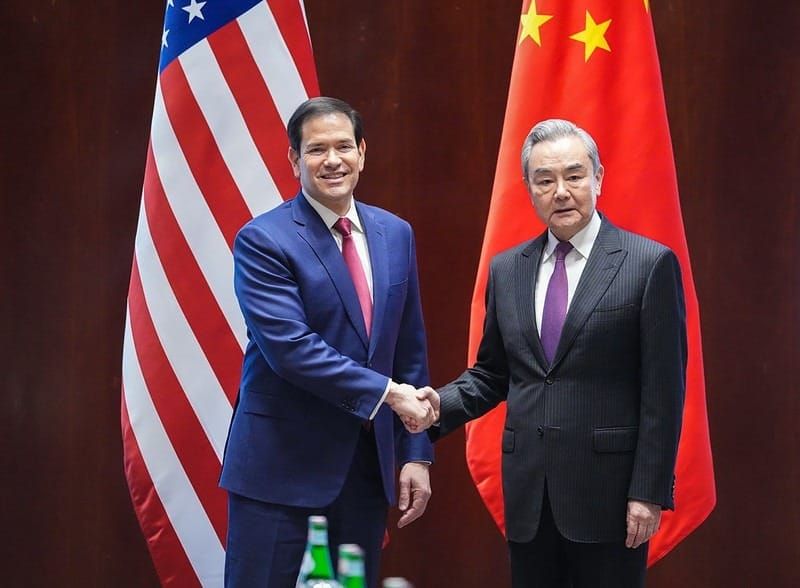
At the Munich Security Conference, which took place last month, US Secretary of State Marco Rubio appeared not merely to reference Europe’s imperial past, but to celebrate it. He opened by recalling a pre-Second World War Europe that built ‘vast empires’ that ‘extended far across the globe.’
Centuries of conquest, extraction and racial hierarchy across Africa, Asia and the Americas, reduced to expansion.
Empires were not abstract achievements; they were systems sustained through violence, dispossession and enforced hierarchy.
When Rubio argues that Europe should not be ‘shackled by guilt and shame,’ he is advancing that the legacy of imperialism should not limit present power. Guilt and shame are treated as obstacles rather than a reckoning.
This position mirrors the United States’ own refusal to confront the consequences of its recent military involvements, from Iraq and the War on Terror to coercive sanctions regimes, and the millions killed directly and indirectly through American campaigns.
Today, Washington’s military and diplomatic backing of Israel’s genocide in Gaza and its war on Iran fit within the same framework in which force is justified as a necessity and dominance as a drive to stability.
This logic becomes explicit when Rubio calls for the renewal of ‘the greatest civilisation in history.’ The claim establishes a hierarchy in which Western political forms are positioned as superior and are justified when intervening. From there, imperial domination can be presented not as aggression but as responsibility carried out under the banner of exporting ‘democracy.’
Europe’s empire may belong to the past, but America’s dominance remains very much present. Through this rhetoric, the empire is not treated as history to be reckoned with, but as a template to be revived. By framing guilt as weakness, the speech clears moral space for any contemporary project that sees power as inherently valuable, whether it be geopolitical intervention, economic coercion or, as the world now watches, the genocide carried out against Palestinians. To erase guilt is to open the door to repeating violence and colonial forms of domination.
This same structure of argument appears, in a different register, in American Politician Mike Huckabee’s recent interview with journalist Tucker Carlson. Though framed in religious rather than civilisational terms, it rests on the same premise that expansion and territorial domination are not merely strategic options but moral entitlements.
When asked whether biblical geography implied sovereignty beyond Israel’s current borders, Huckabee replied that ‘it would be fine if they took it all’ - ‘all’ referring to parts of Syria, Lebanon, Egypt, Jordan and Saudi Arabia. The casualness with which he entertains a territorial expansion of that magnitude is striking.
Huckabee’s remarks do not merely allude to expansion, they normalise it. When asked whether Israel might seize additional territory in the context of war, he responds that if neighbouring states attack and Israel prevails, ‘that’s a whole other discussion.’ The implication is unmistakable: conquest is acceptable if it succeeds. Borders are not fixed but negotiable through force. This is not defensive realism; it is a revival of the old imperial maxim that victory confers legitimacy in dispossession.
What sits beneath this language is an unspoken hierarchy. Expansion is imaginable because the land in question is Arab/Muslim, and the people who inhabit it are treated as politically and morally expendable. The presumption is not only that power justifies itself, but that some sovereignties are less sovereign than others. In that hierarchy, Western-aligned expansion is framed as security or destiny, while resistance is cast as extremism. Superiority need not be declared openly to structure the argument; it is embedded in whose borders are negotiable and whose lives are rendered incidental.
These statements are not lacking in follow-through. The US has already deposed two foreign leaders since the start of the year. In January, American forces seized control of Venezuelan affairs after deposing and arresting President Nicolás Maduro, declaring that Washington would now ‘run the country’ through control of its oil. Caracas’ resources were redirected and the economic chokehold on Cuba tightened, with regime change in Havana openly discussed. At the same time, renewed pressure over Greenland was framed as a strategic necessity, as if territory can still be negotiated between great powers.
On February 28 the United States and Israel launched a surprise attack on Iran, killing Ayatollah Ali Khamenei and striking a primary school that left 153 girls dead. Almost immediately the language shifted to regime change. Marco Rubio described Iran as a state run by ‘fanatical religious leaders,’ while Donald Trump suggested that the ‘Maduro scenario’ could be repeated, promising that Washington would help install a ‘great and acceptable leader.’ The stated justification is Iran’s nuclear programme. Yet the United States and Israel both possess nuclear weapons. The question is simple: why does Washington believe it has the right to decide which countries can have them, and which governments must fall for trying?
This is the language of an earlier era. Colonial powers toppled governments for resources. They treated smaller nations as leverage. They reduced land to assets and populations to obstacles. We are told the world moved beyond that order, that sovereignty and international law replaced imperial conquest. Yet the logic on display is the same. Only the vocabulary has changed.
Expansion and domination are no longer exceptions but routine instruments of American foreign policy. Civilisational superiority and divine mandate may appear distinct, but both rest on the same premise: that some political orders are entitled to expand and others are expected to yield, that Western civilisation is inherently superior to all other ways of life. When guilt is reframed as weakness and domination as renewal, empire is no longer something to reckon with. It is something to revive.