‘Men don’t read, silly!’ - Hunting Performativity Toward Conformity
Kristi Greenwood, Contributing Designer, BA Japanese
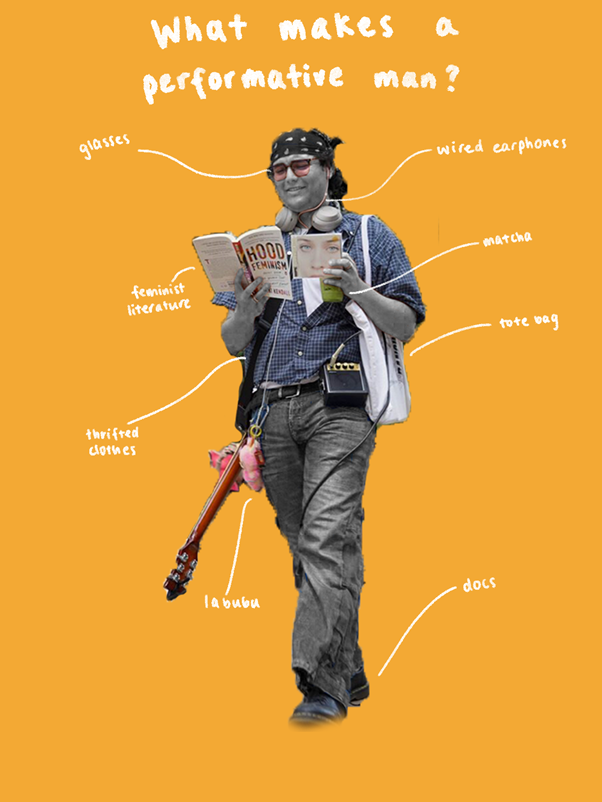
December finished with a ‘performative male contest’ at SOAS, with individuals taking to the stage in ‘I hate period cramps’ hoodies, ‘reading’ feminist literature, and Labubus hung on carabiners. The contest was a huge hit with SOASasians, platforming the Queersoc and Feminist society, the latter, which ‘campaigns against gender based violence and mishandling of sexual assault cases on campus.’ Feminist Society deemed it a great way to promote their work, ‘as everyone finds the performative male trend funny.’ We all know too well that SOAS is rife with these fallacious feminists. However, what began as a genuine way for women dating men to warn each other has now been moulded by social media into a dog whistle: a label for men who fail to conform to traditional gender norms.
The ‘performative male’ trend felt satisfying at first. For once, men were subject to stereotypes where women held the authority. Women's interests have long been dismissed as lacking substance, ridiculed, and labelled as inauthentic, particularly when women engage in traditionally male-dominated hobbies. However, the trend has evolved to ultimately reposition women as the punchline. The humour stems from a familiar assumption: why would a man engage in women's interests unless to sleep with them?
It isn't just feminist literature being ridiculed, but reading itself, as the most use a man gets out of ‘A Room of One’s Own’ is to prop it between the bedrail and the wall. Men don’t read, silly! Reading for pleasure becomes feminised and ostracised from men, and this trend could not have been more ill-placed, with global literacy rates declining, increased reliance on AI and indoctrination into far-right ideologies that thrive on the lack of the very skills reading provides.
Worldwide, literacy rates are sharply declining, with the steepest drop among boys. In 2025, in the UK, the percentage of children and young people who said they enjoyed reading was at its lowest in 20 years, reported the National Literacy Trust (NLT). Only 32.7% children and young people aged 8 to 18 enjoyed reading in their free time, a 36% decrease since 2005. The decline is particularly steep among boys aged 11 to 16, whose reading scores are falling faster than those of girls. Boys are also more likely to describe reading as ‘unmanly.’ As NLT CEO Jonathan Douglas warned, ‘We are witnessing the lowest levels of reading enjoyment and daily reading in a generation, a critical challenge for literacy, wellbeing and life chances. Children’s futures are being put at risk.’ Boys are disengaged from reading and locked onto social platforms promoting media which reward simplification, outrage, and misinformation.
Boys learn behaviours labelled as ‘performative’, which becomes synonymous with feminine, and invites ridicule. Gender norms tighten, and men stray to rigidly ‘acceptable’ hobbies. What started as a feminine critique ends up reinforcing the very thing feminists seek to dismantle: the policing of gendered behaviour.
A critique of performative allyship has expanded into a broader surveillance of masculinity itself. Self-expression through femininity is labelled as inauthentic, implying the existence of an ‘authentic’ male. Now, videos are popping up of the ‘anti-performative male’, portraying a beer-drinking, football-watching, and steroid-fuelled gym-going male, all exaggerated performances of masculinity rebranded as authenticity. This is a slippery slope into manosphere content, where in the UK, 1 in 4 16-24 year old males who had heard of Andrew Tate, agreed with his views, according to a survey conducted by HOPE not hate in 2025.
We are all performing in some way or another, and we should allow men to explore softer avenues of masculinity without jumping the gun to label them as performative, simultaneously preserving the message of this trend: men leveraging feminisms for access to women's bodies.