Roaming Reporter: ‘The Palestine Exception’
By Sam Lailey, MA Anthropology of Global Futures and Sustainability
‘The documentary not only casts the contemporary pro-Palestine movement as a continuation of previous student protest campaigns, but provides a historical precedent for its simultaneous repression by government and university authorities alike’
On Monday 17th November, I made my way down to the Genesis Cinema in Whitechapel for a screening of ‘The Palestine Exception’, directed by Jan Haaken and Jennifer Ruth. This was followed by a short Q&A with Haaken herself. The documentary was shown as part of this year’s London Palestine Film Festival. First established in the late 90s, each year the festival showcases cinematic pieces that reflect on Palestine, both at home and in the wider diaspora. Amid the ongoing genocide of Palestinian people, livelihoods and identities, the festival’s mission has perhaps never been more important.
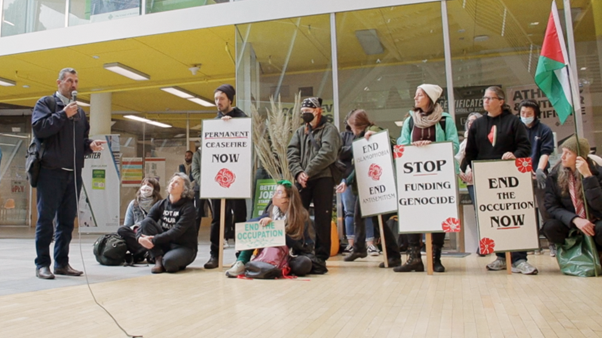
In some ways, ‘The Palestine Exception’ is a uniquely American story. It follows the emergence, and subsequent repression, of pro-Palestine activism on US college campuses across the country. This activism has largely drawn inspiration from the Boycott, Divestment, Sanctions Movement (BDS), as students campaigned for their university authorities to suspend ties with, and withdraw investment from companies, institutions, individuals, and entities complicit in the violation of Palestinian human rights.
The documentary brilliantly interweaves two threads of a connected, but complex story. The first thread traces how the pro-Palestine movement emerged out of an older tradition of student activism in the US. Footage from historical campaigns for global justice pepper the documentary. We see anti-apartheid activists, Civil Rights activists, students peacefully protesting the pummelling of Vietnam, Laos, and Cambodia with millions of tonnes of US-dropped bombs. All of these campaigns, which sought to fight off violent systems of domination and subjugation, have provided the foundations for what has today become the struggle against Palestinian erasure. We also see that the state-sponsored repression of such activism was ever-present. I was left particularly shaken by footage that captured the moment the National Guard opened fire on peaceful anti-war protestors at Kent State University in 1970. Four students were killed. I could feel the gunshots echo around the cinema.
Police repression of pro-Palestine activists continues today. This was brutally demonstrated at the University of California, Los Angeles (UCLA) in 2024, when both university authorities and the police stood by as pro-Palestine protestors came under attack from a violent group of Zionist agitators. Later, the university asked the police to ‘forcibly remove people expressing pro-Palestinian views’, which resulted in riot police violently detaining student protestors and storming their positions. In this sense, the documentary not only casts the contemporary pro-Palestine movement as a continuation of previous student protest campaigns, but provides a historical precedent for its simultaneous repression by government and university authorities alike.
This brings us to the second thread of the documentary: Zionism’s political hegemony in US politics. Perhaps not since the era of McCarthyism and the ‘Red Scare’ has any one issue received as much widespread hostility from the US political establishment as Palestinian sovereignty. The film’s directors demonstrate that Zionism’s chokehold on US politics runs deep, and across party lines. Joe Biden appears several times voicing his fervent support for Israel at different moments in his political career. At one point he asserts, ‘were there not an Israel, the United States of America would have to invent an Israel to protect her interests in the region’. This is an ominous reminder of how military strategy has so often come to trump questions of basic human rights within US foreign policy. At other times, the pro-Zionist fervour of self-avowed Christian politicians appears almost comical. The audience erupted with laughter when we were shown footage of Republican Congressman Rick Allen asking the President of Columbia University if she was concerned that God would curse her university because of the pro-Palestine protests on her campus. This is just one example of how distorted the logic of the ‘Palestine Exception’ has become.
Another of the documentary’s strengths is bringing the testimonies of Palestinian students and academics together to reveal campus activism not as part of some abstract protest against authority, but as a movement grounded in all too real suffering. At the same time, the documentary skilfully and sensitively foregrounds the stories of Jewish activists that have grown up with strong ties to Israel, but have since come to denounce the actions of the Israeli government. This not only voices the internal struggle experienced by many Jewish activists, but serves as a rebuttal to the widespread conflation of anti-Zionism and anti-Semitism, which as we see in the documentary, is often weaponised against protestors.
As Haaken captured after the screening, this documentary is many things. She explained how the intention was to create a form of social memory, which would act both as a tribute to honour pro-Palestine activists, and provide lessons for future protest movements. However, if I have one criticism, it would be in reference to this last part. In my eyes, the documentary was more testament than teaching. In the Q&A, Haaken discussed some of the internal fissures that developed within the pro-Palestine movement itself. She recalled how at Portland State University, some activists made the controversial decision to occupy the university library. Others in the movement were sceptical about what this would achieve, instead arguing that it would only alienate the wider public from the Palestinian cause. Yet, this disagreement did not appear in the documentary. In order to truly learn lessons for the future, it is important to reflect on how and why such tensions manifest, and to study a movement’s weaknesses as well as its strengths. Voicing internal debates is a crucial part of this process, and would perhaps make for an excellent follow-up project.
For many students at SOAS, I doubt that the contents of this documentary will come as a revelation; after all, the US government’s unwavering support for Israel is no secret. Neither is its repression of pro-Palestine student activists, (or of student activism more generally), which has been widely documented in the media. But it did spur me to question how the ‘Palestine Exception’ also applies to the UK. As I write this piece, dozens of protestors are being arrested up and down the country for carrying placards in support of Palestine Action. Hundreds more are likely to follow in the coming days. Is this the British version of the ‘Palestine Exception’? If we are to take anything from this documentary, we must recognise that we have a duty to question structures of authority when they take serious action against individuals or specific groups, and to demand full transparency in the decisions behind such actions. What precedents do they set? Who do they protect? Who do they further marginalise? These kinds of questions are the only thing that blocks the path to unfreedom.
The documentary’s ending serves as a chilling reminder of why we protest. The screen tells us that all 12 of Gaza’s universities have been destroyed. In Gaza, where the right to education has quite literally been razed into the ground, academic freedom seems like a distant possibility. This repression is just one part of a wider regime of violence that has killed tens of thousands of Palestinians, maimed many more, and left countless souls kinless and homeless. But in spite of this unspeakable brutality, one day, another generation of Palestinians will emerge from the rubble. We owe it to them to keep shouting.