
SOAS Newsletter 12/12/2025
Welcome to the first SOAS Spirit Newsletter of this academic year!
Our team of staff writers have been hard at work to keep you up to date with any recent developments that might have otherwise escaped your attention. This edition includes student demonstrations, the recent overhaul of the UK’s asylum system, protests at the COP30 summit, an update on the Gaza ceasefire, and SOAS’ second-ever Shit Conference.
We hope you enjoy reading!
Student Demonstration over UoL Injunction
By Sam Lailey, Senior Staff Writer, MA Anthropology of Global Futures and Sustainability
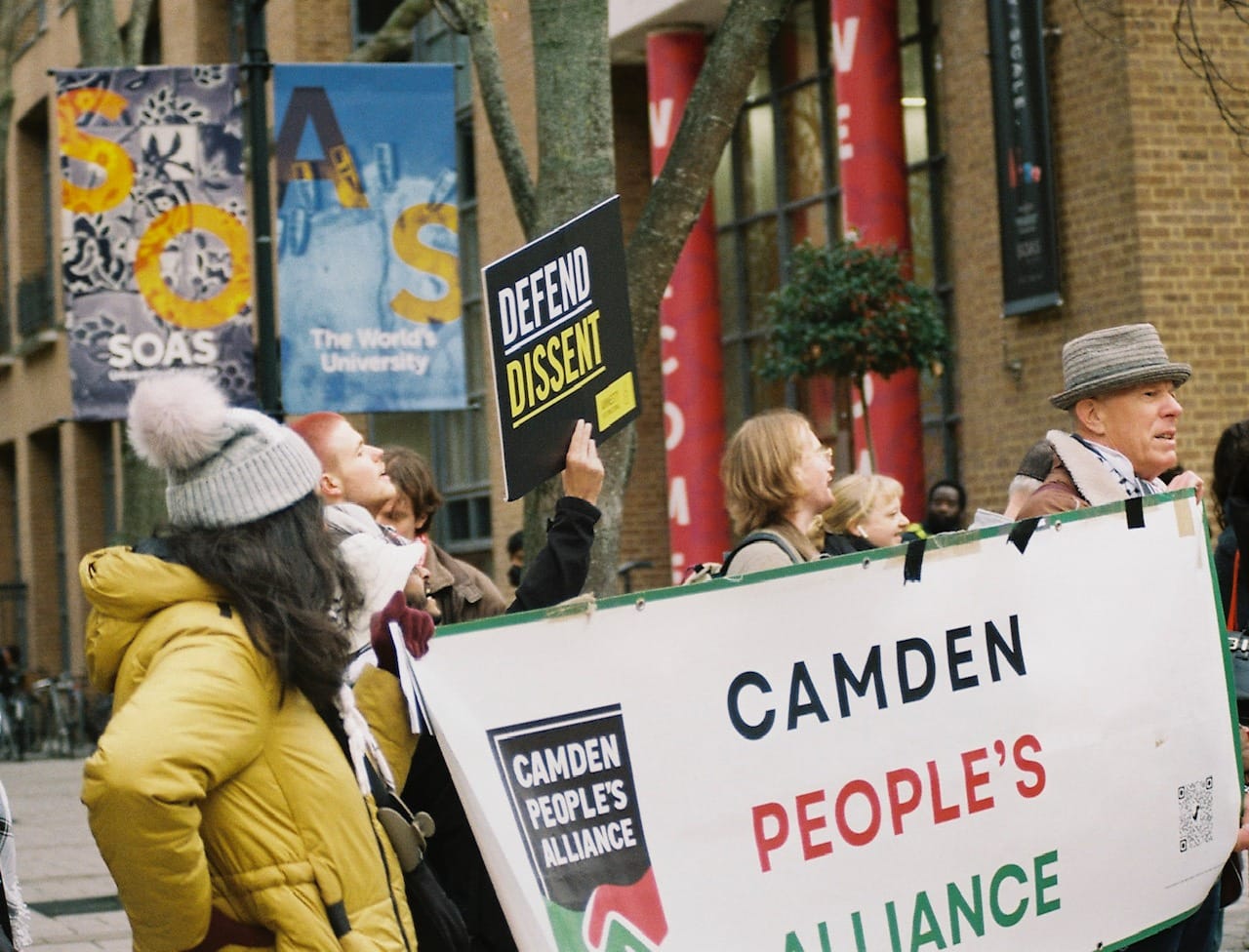
Credit: Kiyana Nahvi
On Friday 5th December, dozens of SOAS students attended a rally opposite the library to demonstrate against the University of London (UoL) Injunction. The Injunction is controversial within the student community; it sets certain conditions on the ability of students to protest, such as the need to notify UoL of planned demonstrations at least 72 hours before they occur, and the need for organisers to receive written approval from the university before protests can go ahead. Campaigners hope that this demonstration will serve to spark a revitalisation of student activism on campus and put pressure on UoL to end the injunction.
While the rally mainly centred around pro-Palestine activism, a diverse coalition of different student (and non-student) groups attended. A speaker from JSoc (the Jewish Society of SOAS) accused SOAS of ‘flattening complex Jewish identities into a singular non-representative monolith’, calling for the university ‘to engage in good faith with its base of anti-Zionist Jewish students whose existence has thus far been erased.’
Another student representative from Justice for Workers voiced demands for the university to treat its cleaners with more respect, by allowing them to speak their native language, Spanish, in meetings.
SOAS Amnesty Society and the non-student Camden Peoples’ Alliance also attended the demonstration.
Mahmood Overhauls UK Asylum System
By Zainab Syed, Sports and societies staff writer, BA Politics and International Relations
On 17 November 2025, Home Secretary Shabana Mahmood set out what she calls ‘the most significant reform to our migration system in modern times’. According to the Home Office’s policy statement ,‘Restoring Order and Control’, the new system establishes that refugee ‘leave to remain’ will be limited to ‘30 months’ instead of the current five years. Long-term settlement will only be possible after ‘20 years’ in the UK, replacing the previous five-year pathway. The Home Office frames these changes as ensuring protection is granted only while it is needed, shifting the focus from permanent refuge to conditional, temporary status.
The reforms remove the automatic duty to provide housing and basic support, introducing discretionary assistance and requiring some asylum seekers to contribute to accommodation costs based on their means.
Alongside these measures, Mahmood promotes the expansion of ‘safe and legal’ routes for refugees, including community sponsorship schemes, work-based visas, and study-based pathways. While these pathways are designed to manage irregular migration, they are selective and limited, effectively channelling only a fraction of asylum seekers into structured entry.
The overhaul also strengthens enforcement, including the reintroduction of removals for refused claims, and streamlines the appeals process. This reinforces the message that access to protection is both temporary and conditional, redefining the relationship between refugees and the state.
By modelling parts of the reforms on Denmark’s temporary-protection system, Mahmood signals a shift in the UK’s approach to migration policy. The political logic is clear: these reforms project firmness and order. However, they also institutionalise uncertainty for those seeking refuge.
The announcement represents more than a policy update. It reshapes the UK’s asylum system, emphasising control over permanence and conditional support over certainty, and sets a precedent for how temporary protection might become the default standard in UK immigration policy.
SOAS Students Stage Palestine Protest outside the South Korean Embassy
By Sam Lailey, MA Anthropology of Global Futures and Sustainability
On Wednesday 27th November, a small number of SOAS students held a demonstration outside the South Korean embassy in London to protest the role of Dana Petroleum and its owner, the Korea National Oil Corporation (KNOC), in facilitating the exploitation of oil and gas reserves off the coast of Gaza. The demonstration was spearheaded by BDS Korea, which organised simultaneous protests in Aberdeen (where Dana Petroleum is headquartered) and Ulsan, South Korea.
Since October 2023, Israel has sold 12 offshore oil and gas licenses to private companies generating a revenue of more than US$15 million, according to Friends of the Earth Scotland. A significant proportion of the area covered by these licenses lie within Palestinian waters.
Demonstrators carried placards that read ‘Dana Petroleum & KNOC: Don’t Fuel Israeli Genocide.’ Inconveniently for the rally's speakers, the demonstration coincided with the farmers' protest against Rachel Reeves’ new Budget, meaning they had to fight to be heard amid the drowning noise of tractor horns.
At the end of the demonstration, a petition with over 10,000 signatures was handed by the organisers to a representative from the South Korean Embassy. The petition demands an investigation in Dana Petroleum’s business activities in occupied Palestine, and for KNOC to immediately end ‘the illegal looting of Palestine’s gas resources and to withdraw from their contract with Israel.’
Indigenous Groups Lead Major Protests at UN Climate Summit
By Anon Yu Henriksen, International News Staff Writer, BA International Relations and Korean
COP30, the 30th UN-hosted climate summit, was recently held in Belem (November 10-21), an Amazonian city in Brazil. The summit saw considerable protests from both indigenous and climate action groups, marking the first major protests since COP26 was held in Glasgow four years ago. The previous three host countries, Azerbaijan, Egypt, and the UAE, are all known for heavy-handed protest repression.
During the summit’s first week, two indigenous-led protests managed to disrupt the conference. Their demands centred on reparations as well as increased representation. As many indigenous groups lacked accreditation to enter the summit compound, one of the protests led to violent clashes with security personnel as it attempted to enter the summit gates.
The other protest managed to block the summit entrance for two hours in an attempt to increase awareness about the marginalization of indigenous communities and their lack of representation at the event. Others counter that COP30 had the highest indigenous representation ever at a UN climate summit. However, for the indigenous groups who were denied access, this made little difference. These grievances were compounded by the political clout that fossil fuel lobbyists so obviously continue to wield.
Following these two indigenous protests, the ‘Great People’s March’ took place on the first Saturday of the summit. The preceding week saw diplomatic negotiations get stuck over trade measures, weak climate targets, and demands that wealthy states increase their financing of climate adaptation in poorer states. In response to the underwhelming results of the first week, protestors gathered to further their demands for representation, reparations, a fossil fuel phase-out, as well as for Palestinian liberation: a giant Palestinian flag was carried through the procession.
According to the organisers, over 50,000 people joined the protest, which peacefully dispersed after encountering soldiers at the summit entrance. The deployment of soldiers has been criticized by some as part of the increasing militarisation of such summits.
On the Monday following the ‘Great People’s March’, the Brazilian government announced it would create 10 new indigenous territories. This policy grants certain areas special legal protections, and was celebrated by indigenous leaders, despite its somewhat convenient timing.
Gaza since the Ceasefire
By Lina Kabbour, Culture section staff writer ,BA Politics and International Relations
On 10th October 2025, a ceasefire deal, brokered by the US, was agreed upon by Hamas and the Israeli government. The agreement included Trump's 20-point peace plan that most notably outlined an end to military activity, an exchange of Israeli hostages and Palestinian prisoners, a flow of humanitarian aid, and a call for Hamas to disarm.
The peace plan also stated that there would be a temporary transitional government in Gaza called the ‘Board of Peace’. This would be run by technocrats, and in theory would focus on programmes to provide economic development in Gaza, and a pathway for Palestinian statehood and self-determination. Trump said on the day the deal was passed on Truth Social that it was ‘the first step toward a strong, durable, and everlasting peace.’ However, the reality on the ground could not be further from the ‘everlasting peace’ that Trump envisioned.
Since the implementation of the ceasefire, over 360 Palestinians have been killed in Israeli airstrikes, many of whom were civilians, according to Gaza’s health ministry. Amidst these constant breaches of the agreement, Israel has continuously claimed that their attacks are due to aggression from Hamas, which Hamas has repeatedly denied.
Gazans, who have already had to face 2 years of genocidal violence, feel as though they are stuck in a never-ending nightmare, with a mother telling Agence France-Presse that 'Every time we try to regain hope, the shelling starts again.'
Furthermore, the flow of humanitarian aid into Gaza has been constantly obstructed by the Israeli government, which has only opened three out of the seven border crossings. According to the United Nations Office for the Coordination of Humanitarian Affairs (OCHA), this has greatly limited Gazan’s access to daily necessities.
Therefore, the future for Gazans remains shrouded in uncertainty, perpetual violence, and economic instability, and the ‘peace’ of the ceasefire agreement seems to be true only on paper. In the absence of stronger pressure on Israel to end the violence and allow the passage of aid, the situation in Gaza can never truly be resolved.
Who is to sit on the ‘Board of Peace’ is yet to be decided.
The Second SOAS Shit Conference
By Sam Lailey, Senior Staff Writer, MA Anthropology of Global Futures and Sustainability
For some slightly more positive news, this November SOAS held its second ever ‘Shit Conference.’ While the conference may have escaped your attention as it was not officially advertised by the university, it took place from 18th to 19th November in a small room on the 4th floor of Senate House.
Over the course of these two days, some fascinating lectures were given by world-leading experts in, well, shit and everything that relates to it. Talks ranged from gendered insights on sustainable sanitation to discussions of how the freshwater-flush toilet has come to so rigidly dominate the way we think about human waste disposal. The event even managed to attract a number of students from the London School of Hygiene and Tropical Medicine.
One of the best lectures was given by Dr. Sarah Nahar who brilliantly introduced the concept of ‘defecatory justice’, in which she combined the theoretical concerns of social and environmental justice with the practical concern of keeping human waste within natural cycles of decomposition. Her work contributes to a significant rethink of the homogenous way in which the Global North approaches human waste today. Food for thought indeed!