
Eighty-One Years on, Gaza and Srebrenica Expose Different Limits of the Same Institution
Written by Salsabeel Yasir, International News Editor, BA International Relations and History.
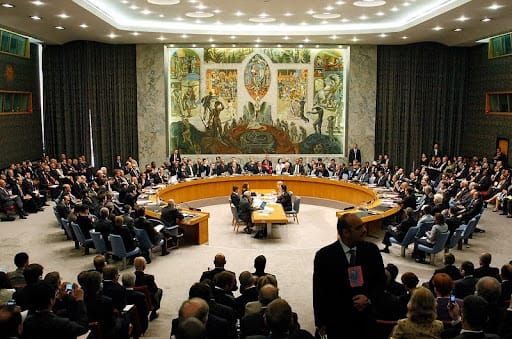
October marks 81 years since the UN Charter came into force. The UN presents itself as the central institution for maintaining international peace and security. However, its ability to enforce that purpose has depended on five states with permanent seats and veto power: the US, the UK, China, France, and Russia. This raises the question of whether the UN is failing in its purpose, or revealing the structural limits of its design.
The UN Charter, which came into force on 24 October 1945, states that its purpose is to ‘maintain international peace and security,’ and take ‘effective collective measures’ against threats to peace. However, Article 27 requires the concurring votes of the permanent members for substantive Security Council decisions, effectively giving each a veto. This structure was not accidental. At Yalta in February 1945, Roosevelt, Churchill, and Stalin negotiated the new organisation’s framework, insisting on veto power to safeguard their national interests. From its drafting, the UN was structured around a hierarchy between the great powers and everyone else: it could establish universal rules, but enforcement depended on the cooperation from the most powerful states.
This hierarchy also emerged in a world still dominated by colonialism. When the UN was founded, much of Africa and Asia remained under European colonial rule, meaning most colonised peoples did not participate as sovereign states in designing the international order. The Charter reflects this reality: Chapter XI is devoted to ‘Non-Self-Governing Territories’, while Article 73 places responsibilities on the powers administering territories whose populations had not yet attained ‘a full measure of self-government.’ The UN thus claimed universal principles within a profoundly unequal international system.
The UN’s failure to take concrete action to stop the genocide in Gaza demonstrates these structural limitations. Since the war began in October 2023, the US has repeatedly used its veto to block Security Council resolutions calling for a ceasefire. This is striking given the Charter’s purpose of maintaining international peace and taking collective action against threats to it. However, maintaining US foreign policy interests seems to take priority over taking substantive action for Gaza. The result is an institution capable of issuing resolutions and calling for peace, but constrained by the most powerful states within it.
Bosnia demonstrates another dimension of the same problem. In 1993, the UN Security Council declared Srebrenica a ‘safe area’ for civilians and deployed peacekeepers to protect it. Yet, in July 1995, Bosnian Serb forces captured the enclave and carried out the Srebrenica genocide, killing more than 8,000 Bosniak men and boys. The UN later acknowledged its failure to prevent the massacre. Srebrenica illustrates that even when the UN commits to protecting civilians, those commitments mean little without the political will and capacity to enforce them.
81 years on, Gaza and Srebrenica expose different limits of the same institution. The UN can articulate universal principles and create mechanisms for collective action, but enforcement depends on powerful states. The question, then, may not simply be whether the UN has failed in its purpose, but whether its purpose was ever separable from the power politics built into its design.