We’re Not Angry Enough
Written by Sylvie Topps, LLB Law.
What happens if, during the first weekend of October, you take the tube right to the end of the Victoria line and walk for ten minutes through an industrial estate?
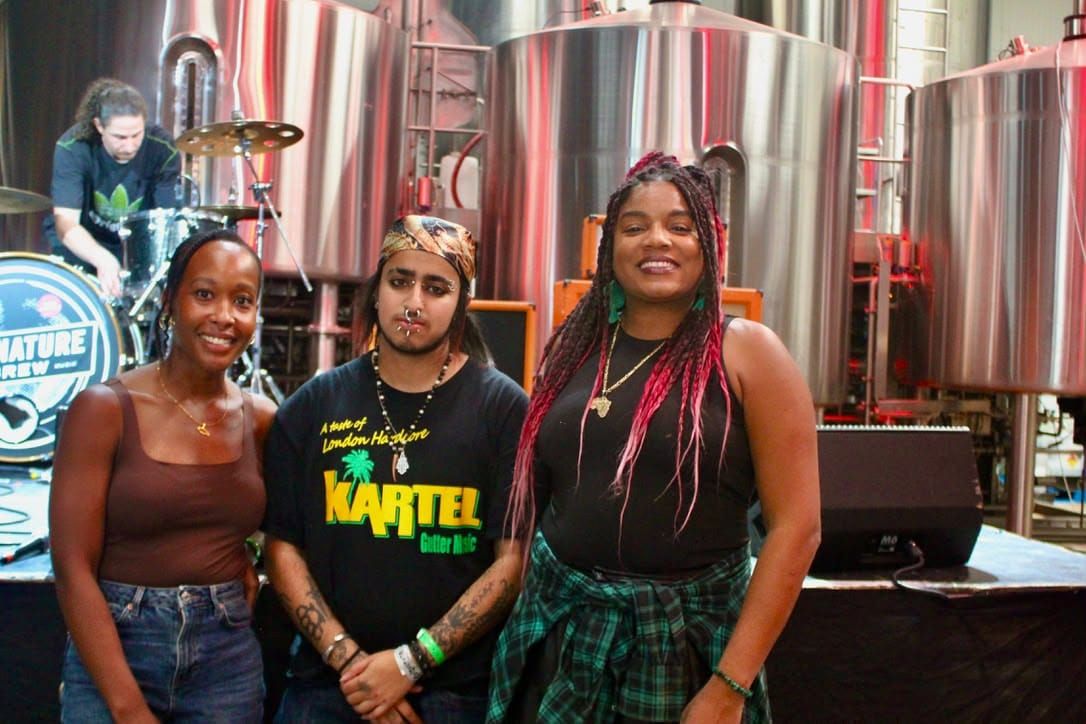
Well, if you’re lucky enough, like me, to end up at Decolonise Fest, you will surely find some punks. There will be punks of many colours, shapes, and sizes. Punks with mohawks, punks with dreads, braids, spikes, and afros. Punks in black leather and pink florals.
"It was both refreshing and eye-opening to be a guest in a space built by the personifications of punk, a space where intersectionality wasn’t the afterthought but the whole point."
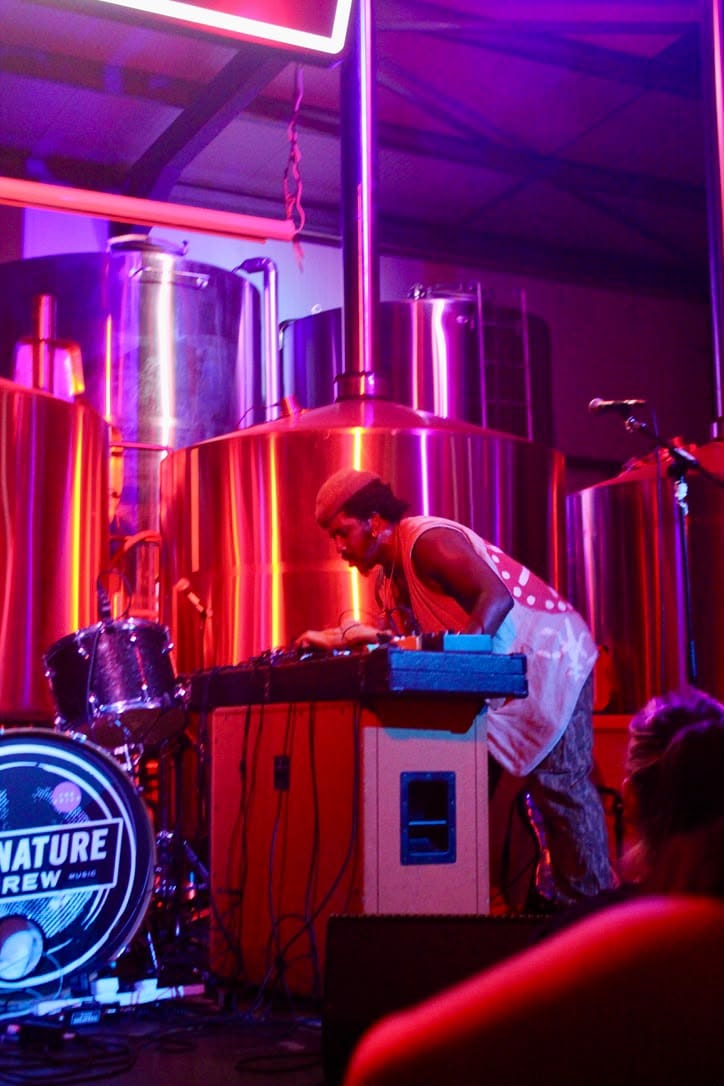
Decolonise Fest first took place in 2017 and returned this year at Signature Brew, Walthamstow, for its ninth weekend. Beneath towering brewing tanks, among stacks of gleaming steel barrels brought a weekend of political and creative workshops and live music curated by activists, militant community organisers, musicians, and artists, to celebrate punx of colour.
I was born into a white British family, with a self-proclaimed punk dad and the privilege of attending countless festivals and gigs. When I think of punk, two musicians come to mind immediately: Joe Strummer, my brother’s namesake, and Poly Styrene, my sister’s namesake (albeit only for two weeks).
Poly Styrene, the British Somali punk pioneer and frontwoman of X-Ray Spex, has always been my favourite punk. I’ve attempted to harmonise ‘Germfree Adolescence’ on many occasions, armed with a stiff upper lip and a posh accent. Her bold, fiercely feminine individuality inspired me, and countless other brace-wearing teenagers, to never, ever shut up.
That being said, my biggest act of rebellion growing up was wearing a pair of Dr. Martens on rural Irish backroads. The punk scene I have known is far from the margins, and the collective between the beer barrels was a ‘festival by and for punx of colour.’ Therefore, I shut up.
Writer and scholar Joanna Davis-McElligott once said, ‘Black punk means liberation, it means doing things for myself, it means family, it means joy, it means healthy rage, it means radical self-acceptance.’ Decolonise Fest was the quintessential embodiment of this.
I travelled to the industrial outskirts of East London on Saturday afternoon and wandered straight into a workshop called ‘Fight Back Against the Far Right.’ The panellists, Vicky Gale, Chantelle Lunt, and Malik EG, emphasised the sharp rise in far-right activity, explaining the ‘disheartening impact of seeing the colonisers' mind in modern Britain.’
Lunt, an anti-racist activist, decolonial educator, writer, and PhD researcher at Liverpool John Moores University, exposed the organisation of far-right activity across the UK, focusing on Northern Ireland and Liverpool. She explained that people support the far right because ‘they think it is a space where they will be listened to,’ and challenged this by deconstructing dominant historical narratives and systemic inequalities, offering decolonial education, grassroots resistance, intersectional solidarity, and lasting social change.
Malik, a member of Infilaat, a political, community-driven collective run by people of colour and committed to rebuilding punk as an inclusive and educational space, spoke about the struggle of creating spaces of joy when ‘you don’t see people of colour coming to shows.’ Speaking as a Muslim, punk-loving Arab, they shared how seeing a sign reading ‘BROWN IMMIGRANT MUSLIM AND PROUD – FUCK YOU’ made them feel welcome in the punk and hardcore scene, and inspired them to carve out that same belonging for others.
For Malik, punk is not only about the noise on stage but about who feels safe enough to stand in front of it, and what happens when the margins stop waiting for an invitation.
The prevailing verdict in the warehouse was that to fight, we must fuel ourselves with anger. This type of anger is far from bitterness; rather, it is anger as refusal. Refusal to live with the rise of the far right as normal, to be lulled by the comfort of a passive, censored scene, or to wait for someone else to organise. Against that, indifference is a luxury, and politeness is not a strategy.
Punk is many things, but it certainly shouldn’t be luxurious and polite. Lunt’s ‘spaces of joy’ and Davis-McElligatt’s ‘healthy rage’ were sitting in the same room, and neither one cancelled the other. Rage names what is wrong, joy shows what is worth defending, and punk, at its best, holds both.
You can only talk about politics for so long before you need to hear someone scream about it, and thankfully the weekend had a twelve-act lineup that reflected the vast diversity of punk/alternative music. From the alternative punk-rap trio Frozemode to the Scottish indie-pop band Sacred Paws, no two acts were the same, and yet the crowd was as spirited for them all. The energy felt different to any 'punk' gig I’d been to before. It felt collective and unmistakable: not a sound or a uniform but an energy and belief in better that filled the warehouse and belonged to everyone in it.
I got to speak to the kind-eyed and wide-smiled Hang Linton. When I asked what message they would give to SOAS students, they said, ‘No one has your experiences, your perceptions, you are unique in your expressions of life and creativity. These expressions are what people want.’
They then got up on stage and performed a one-man show of protest songs with punkifying Medusa eyes. Spellbound, the crowd embodied post-colonial, post-punk. The creativity of Linton is what the people want: raw, honest and provocative, their unique perception and experiences are what people need.
Punk purists will point out that this experience is no five-quid gig. A day ticket starts at £21, and the weekend pass runs from £40 to £55 - which is a lot if you’re a student or out of work. But the tickets are on a sliding scale, where you choose between low-waged, standard, and solidarity depending on what you can afford, and those who can pay more cover those who can’t.
The festival is non-profit, part-funded by Arts Council England and the PRS Foundation, which definitely isn’t anti-establishment, but it’s also what keeps twelve bands and six workshops under the price of most London festivals. The underfunding of the arts is a whole other angry article of mine, but it’s worth saying here that spaces like this shouldn’t have to scrape together grants to exist.
And yet, despite the reasonably priced tickets and well-programmed events organised with care, the warehouse felt emptier than it deserved to, and it’s hard not to ask why. Maybe the price is still too high for the people it’s meant for, sliding scale or not, especially in a city where rent alone devours the maximum student loan and the arts are a luxury for many.
Maybe the lineup was too “alternative” for a punk scene that has always policed its own borders, and that hears ‘indie-pop’ or ‘punk-rap’ and assumes it just isn’t for them. Maybe the hope of true punk has been lost. Or maybe the problem is us. Maybe we hold out for the headline act, the sponsor or the viral clip before we decide something is worth our time, and then complain when it becomes commercialised. Maybe we simply don’t believe a room can change anything, socialised into believing our rage is counterproductive.
SOAS is a university that teaches decolonisation, has had an SU debate for every cause going, and has built a reputation on student rebellion. Yet a festival built on those same ideas, a ten-minute walk from the end of the Victoria line, was missing us. SOAS began life in 1916 as the School of Oriental Studies, and the argument over what it owes the people it studies, and what it should do about its own history, can’t just be a lecture or a reading list. It’s easy to be radical on paper.
We can write the essays, share the infographics and agree, correctly, that margins matter. But if we mean what we say in seminars about the importance of decolonising culture, we need to turn up for the people already doing it, pay the price, if we can, and stay for the last act.
I grew up at festivals because my parents worked them, and punk was the part of that often-commercialised world that felt like mine. For me, those summers spent listening to a working-class noise, loud and unimpressed, felt like my fight against expectations to be polite and quiet in school. Class gave me a way into punk, and I never felt the need to fight to be represented.
I loved Poly Styrene, but she was one of very few punks of colour the mainstream ever let in. This was the only festival I have ever been to which ‘centres the experiences of punx of colour’ to ‘celebrate the many punx of colour creating right now[…] and make room for more DIY punx of colour to take centre stage and make some noise.’ It was both refreshing and eye-opening to be a guest in a space built by the personifications of punk, a space where intersectionality wasn’t an afterthought but the whole point.
That is what Shawna Shawnté, organiser of Black/brown punk festivals, meant when she said, ‘We have been pushed to the margins, but we create in those margins. It doesn’t get more punk than that.’
At the end of the Victoria line, at the margin of seasons, there is an abundance of liberating creativity. Grab the quick-to-rise hand of a radical classmate, skip through Walthamstow, and let out some healthy rage. Go home a bit more punk.