I Came to SOAS With Stories. A Year In, I Have Better Questions
Written by Kojo Kamara, MA Medical Anthropology and Mental Health.
I came to SOAS carrying several versions of myself. Actor, writer, musician. British, with Ghanaian and Sierra Leonean heritage. I had spent years telling stories, playing characters, and working in an industry where uncertainty is part of the job description. I came with the lived experience, but perhaps not the language for what I was living.
SOAS gave me some of that language. It also gave me more questions.
In one of my first essays, I wrote about anxiety and precarity in creative labour. As an actor, I knew precarity before I knew the academic word for it. Waiting for the phone to ring. Auditions. Rejection. Money coming in and then not coming in. Somehow being expected to remain hopeful. Before SOAS, I internalised a lot of that. What am I doing wrong?
Anthropology shifted the question: what kind of industry produces this way of living?
"I think SOAS has made it harder for me to leave things alone."
My life had become material for thinking.
That started happening elsewhere too. Studying the body made me reconsider something I had worked with my whole career. As an actor, my body communicates before I say anything. As a saxophonist, breath becomes sound. Suddenly, the body wasn't just something I performed with. It was carrying things too: memory, anxiety, culture, history. Sometimes before we have the words for it.
But some of my best education at SOAS hasn't happened in a classroom.
You leave a tutorial, start talking to somebody who isn't even studying your subject and 20 minutes later you're somewhere between migration, music, politics, and identity. I have walked away from those conversations with thoughts that later found their way into my writing. That is something I love about SOAS. Ideas don't always stay where you found them.
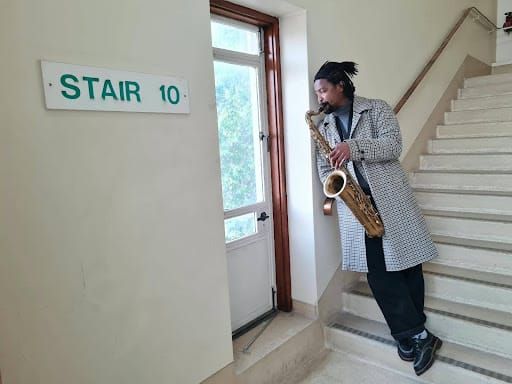
Most afternoons after five, I take my saxophone into Senate House at a space I call ‘Stair 10’ to practice. Then I started listening differently. The same note behaves differently depending on where I stand. A stairwell gives something back. A corridor gives something else. People walk through the sound, stop, listen, or carry on. Without really planning it, practice became enquiry.
That curiosity eventually entered my ethnographic work and left me with a question I keep returning to: what counts as knowledge?
An essay? Of course.
But what about a conversation? A body? A story?
And if anthropology is supposed to help us understand human experience, why should that understanding only live in academia? Which leads me to the question I have wrestled with most: who is academia for?
I struggle with academia when its only audience seems to be academia. I am drawn to action. So I keep coming back to a fairly simple question: what are we going to do with all this knowledge?
How does anthropology become meaningful to Tracy in HR or Nigel on a council estate, neither of whom may ever pick up an anthropology journal? Can research become a television drama, a play, or music? Can it move somebody before they know they're engaging with anthropology?
Studying part-time has helped. It was one of the best decisions I made because I needed time to let anthropology marinate. ‘Anthro-speak’ and I have not always been friends. Some texts I have read three times and still thought, what on earth are you actually saying? At first I assumed the problem was me.
Now, after the third read, I consider that the problem might also be them. That might be one of the biggest changes.
SOAS has also made me look differently at my own history. During my time here, a conversation around getting a Ghanaian passport led me towards a documentary about my father's side of the family and a history I hadn't known. I also met one of my sisters for the first time. Suddenly questions of kinship, inheritance, and belonging weren't things I was only encountering in anthropology. They were happening in my own life.
With my mother's Sierra Leonean story, the question is different. I have wanted to develop work around her experience of child marriage, but anthropology has made me stop and ask something I might once have rushed past: just because I am her son, does that make the story mine to tell? I think SOAS has made it harder for me to leave things alone.
An audition isn't only an audition anymore. A story isn't only a story. A passport isn't only a passport. Even playing a saxophone in a stairwell can become a question about space, sound, and who gets to occupy it. That doesn't always make life simpler.
There is probably a version of me before SOAS who could experience something without wanting to pull it apart. Sometimes I miss him. But I prefer the complication.
I came to SOAS thinking acting, writing, music, and academia belonged in different rooms. Now I am less convinced. I can see research becoming a screenplay, ethnography informing performance, or music becoming an understanding of a place.
SOAS hasn't turned an artist into an academic. It has made the artist in me question what academia can do. I'm no longer interested in choosing between artist and researcher. I want to know what happens when the two sit at the same table. I came to SOAS with stories. A year in, I have better questions.
The Japanese term kōjō (向上) means continuous improvement, progress, and elevation. I've always liked the idea of those being a way of living.