Multiple Flash Floods Devastate Nepal
Written by Melina Tavakoli Moghaddam, Editor-in-Chief, BA Politics and International Relations.
On 11 October, Nepal’s Budhi Gandaki River is thought to have been blocked by a landslide, causing a severe flash flood. According to the Guardian, approximately 204 homes were damaged, with roads and bridges being washed away, especially in two villages in the Chumanubri municipality. Of the 650 people affected, 95 people were rescued, and five people went missing. The disaster raises an urgent question: as the planet warms, is Nepal prepared for the next catastrophe?
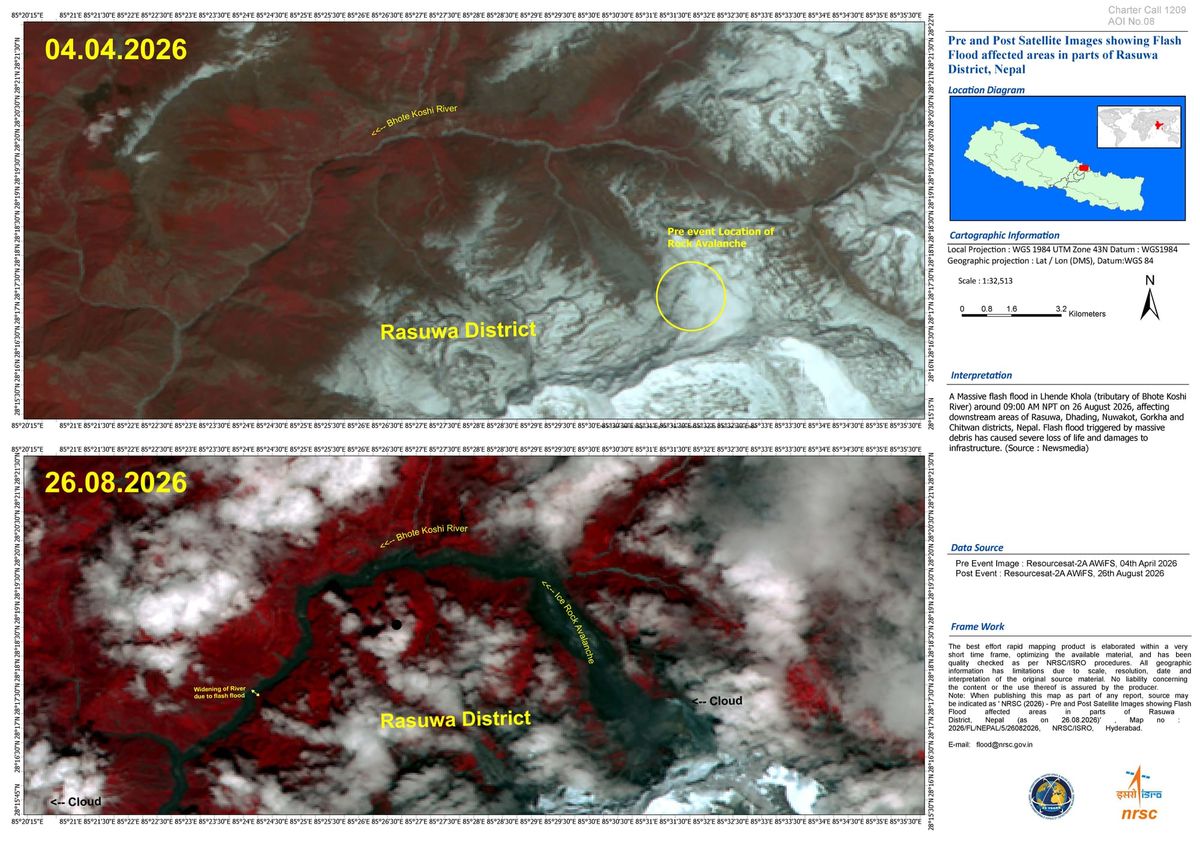
This is not an isolated incident and is in fact following an earlier flood. On August 26, extreme flash floods hit Nepal’s Rasuwa district destroying multiple communities. An estimated number of 93,000 people were affected, with reports indicating that approximately 1,300 people died.
The origin of the floods, according to the British Red Cross, is from the Bhote Koshi River between the border of Nepal and Xizang/Tibet. Though the exact cause has not yet been determined, the current view is that ‘a glacier collapse near the Langtang Lirung peak’ near the Himalayas unravelled the flash flood.
According to a BBC reporter in the rural municipality in Gorkha, what deems the disaster particularly dangerous was that ‘there was no obvious trigger for Sunday’s flood,’ that is, the 11 October flash floods.
Nearly two months after the August flash floods, authorities and several non-governmental organisations (NGOs) are still working to respond to land damages and the communities affected.
The UNICEF global spokesperson, James Elder, recently reported that 5,285 people are still missing in Nepal. UNICEF has thus employed several measures to combat these statistics. These include—but are not limited to— ‘construct[ing] 70 temporary toilets and restor[ing] water supply systems serving approximately 27,000 people, reach[ing] more than 14,300 people with mental health and psychosocial support, [and] reach[ing] risk communication and community engagement for more than 5.9 million people through radio, SMS, digital, and community channels.’
"It seems communities are being left vulnerable at the turn of climate change without preventive government action being taken."
Nepali authorities and the Nepal Red Cross Society have also sent out search parties in affected villages and ‘are supporting ongoing search, rescue, and response efforts.’ Five emergency camps were initially set up and emergency supplies were provided as an immediate response, while the priority now is to reach displaced individuals, reunite them with their families, and rebuild their homes.
As for responses to the recent October flash floods, authorities state that search and rescue operations have been immediately put in place and ‘more than 700 personnel’ have been deployed to affected areas.
The floods come at a time where climate change experts have been reporting extreme pressure levels in both high and low terrains, making this a governmental issue rather than a natural disaster that ‘could not have been prevented.’
Nepal’s floods thus make us question whether governments are truly prepared when such disasters hit them. As families were still recovering from the August flash floods, the 11 October catastrophe hit without anticipation. It seems communities are being left vulnerable at the turn of climate change without preventive government action being taken.