
Roaming Reporter: Saving the World, One Seed at a Time
Written by Sam Lailey, Senior Staff Writer, MA Anthropology of Global Futures and Sustainability.
For my last Spirit article, I wanted to write about food justice, a subject I have been discovering more about over the past year. Yet, it is a topic so infinitely vast that even deciding where to begin becomes a daunting exercise. It just so happens that as I was trying to hone in on something specific, I discovered that Diva, one of my fellow classmates, works at a garden and learning hub in North London called Omved. The garden has recently become a centre for seed saving, which piqued my interest, and so with Diva’s help, I decided to investigate further.
Located off Highgate High Street, Omved Gardens is a two-acre patchwork of winding footpaths, soily slopes, landscaped hedges, vegetable patches, and unruly ponds. The site even boasts an amphitheatre, as well as its own barn and kitchen. It is a busy place, where different projects are constantly unfolding and evolving. It currently serves as the London Action Hub for the Chef’s Manifesto and the UN World Food Programme, as well as partnering with Camden Public Health to engage school children in learning about the natural world.
In 2020, Omved founded the Seed Saving Network. This initiative forms part of a growing number of projects such as the Gaia Foundation’s Seed Sovereignty Programme and the Heritage Seed Library that are working to encourage the saving, sharing and growing of heritage seeds among a diverse community of growers across the UK. As part of their initiative, the Omved team organises seed swaps in which seeds are distributed to growers free of charge, with the hope that growers will eventually return more seeds in the future to increase the overall seed pool. Anyone can sign up to the network, and since its foundation, the project has distributed somewhere between 3000-5000 packets of seeds to growers across the UK (it cannot share seeds outside of the UK due to legal restrictions).
“Vicky described seed saving as a form of ‘active empowerment’, offering a pathway out of intransigent hopelessness towards meaningful action.”
At this point you’re probably thinking, this all sounds rather nice, but why do these seeds need saving in the first place? I spoke to Vicky, one of the initiative’s founding figures, and posed this same question to her. She began by recounting the immense loss in global seed diversity over the past century or so. According to the Food and Agriculture Organisation, since the 1900s the world has lost 75% of its genetic diversity among food crops. This is largely a consequence of agricultural industrialisation, the Green Revolution, and the globalisation of the food system. As a result, diverse heirloom seed varieties - many of which have evolved for generations (if not centuries) in specific local ecologies - have become replaced by far more homogeneous commercial varieties, often under the influence of lobbying from agribusiness. Such a reduction in seed diversity is a major threat to food security, especially in a world where the climate is changing so rapidly. Put in simple Darwinian terms, saving heirloom seeds preserves vital genetic diversity, increasing future capacity for plants to adapt to environmental change. Indeed, a profound concern for our planetary future was one of Vicky’s major motivations for starting the initiative. She said that ever since she was a young child, the pace of environmental degradation had caused her to experience a kind of eco-anxiety. In this light, Vicky described seed saving as a form of ‘active empowerment’, offering a pathway out of intransigent hopelessness towards meaningful action.
While climate change certainly shaped the motivations behind the initiative in crucial ways, Vicky placed equal emphasis on the importance of seed saving for other reasons, such as preserving cultural heritage. She described seeds as ‘living storytellers’ that have co-evolved with their human partners. In this way, the stories behind seeds and the humans that grow them are intertwined, which starkly contrasts with the disconnect between consumers and the mass-produced varieties of fruit and vegetables sold in our supermarkets. Louise, another member of the Omved team, told me how she was now growing pumpkins from seeds that had been donated by a 95 year-old woman called Mama Selena, who had been growing this same variety of pumpkin for most of her adult life. There is some intrinsic value in the passing of this heritage, and in the telling of these stories, that resists capture.
This impulse to grow and keep growing means the project is quite literally alive. In contrast to other, more apocalyptic designs to preserve seed diversity, such as the Svalbard Global Seed Vault in the Arctic that locks seeds away in storage. The philosophy behind the Seed Saving Network very much emphasises the need to keep growing and distributing seeds in the here and now, in order to ensure their future protection. Vicky explained that this not only allows seeds to adapt to climatic variations as they are grown over generations, but that sharing seeds also redistributes risk among a decentralised network of growers. For these reasons, Vicky prefers to use ‘seed library’ or ‘seed network’ rather than the term ‘seed bank’, which has been used in other contexts.
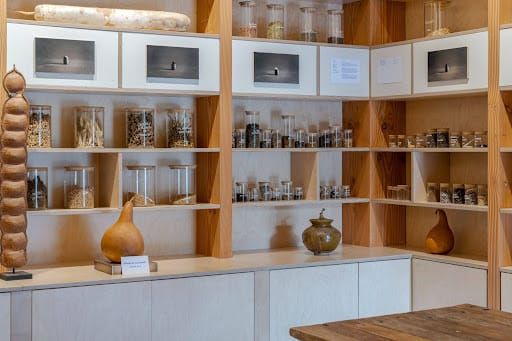
When I was asked if I wanted to see Omved’s seed library for myself, I was thrilled. Louise very kindly gave me a tour. Inside the small, beautifully crafted wooden building were shelves and shelves of countless varieties of seed, neatly arranged in glass containers. Some other oddities filled the space. One of these was a Coco de Mer seed – the largest seed in the world, which dwarfed the size of my head. As I stepped back and absorbed the tranquillity of the space, Louise told me that for her seed saving was a ‘radical but gentle act’. These words stuck with me.
During my visit, I also noticed that many of the heirloom varieties on offer were decidedly unique. A quick scroll through the Seed Saving Network’s online catalogue reveals all sorts of quirky and exotic-looking fruit, vegetables, grains and flowers. Blue Fire tomatoes, cucamelons and Purple Peliti sweetcorn are just some of the available choices. I was keen to ask Vicky more about how the project selected which seeds to save and redistribute. She told me that there are several, sometimes arbitrary, categories they take into consideration. A plant’s rarity, flavour, resistance to disease, and ease of growing all influence selection. As the seed library gets fuller, decisions about what to save and what not to save are becoming harder. Some growers elsewhere have even argued that we should scrap the preservation of heirloom seeds altogether, instead allowing different varieties to mix and mingle with less human interference. There is certainly a kind of politics that lies behind how these choices are made, and it is one that those working at Omved will have to continue to grapple with as they expand the network further.
I concluded my chat with Vicky by asking her what message she would like to share with the wider world. Her answer was practical and simple. ‘Grow something. Try it. Even if it’s only once. This could be in your own backyard or at a community garden. To me, this encapsulated the energy that drives the Seed Saving Network – a desire to reconnect with food webs and partake in the life-journey of food from seed to mouth. After all, in an age where virtually everything we consume is mass-produced through global commodity chains, what’s more radical than growing your own food?