The Cornell University Case is not the Exception
Written by Midnight Adams, Culture Editor, MSc Humanitarianism, Aid & Conflict and Iris Brown, Social Media Co-ordinator, MA Investigative and Human Rights Journalism.
It has been hard to escape conversations around the ‘Cornell 7’ case (an awful use of phrasing that purposefully sensationalises and anonymises aggressors), which has received global attention. But why has this case stood out amongst the thousands of examples of sexual violence on university campuses each year?
For those unfamiliar, the Cornell 7 refers to an incident in October 2024, where seven men of Chi Phi fraternity chapter at Cornell University in Ithaca, America (Matthew Ingalls, Jonathan Newell, Winston Lee, Gillio Lopes, Diego Sarabia, Scott Norris, and Scott Kretzschmar) were accused of gang-raping an intoxicated woman from Delta Delta Delta sorority.
The case gained significant online attention because of the university’s response following an internal disciplinary process: two of the accused were expelled, two were suspended, and three were given sexual assault training and asked to write reflection papers.
This case does not stand in isolation. Sexual violence and rape accusations on university campuses have been ongoing for decades. In 2014, the Columbia University undergraduate Emma Sulkowicz carried the mattress upon which she had been raped by fellow student Paul Nungesser in protest of the university’s inaction.
Even SOAS’ own history indicates a poor ability to adequately support victims of sexual abuse.
The 2018 ‘Account for This’ campaign was formed in response to the university’s failure to address complaints for sexual and gender-based violence (SGBV). The collective had several demands, including a reworking of the SGBV policy, clearer reporting mechanisms, and appropriate sanctions for offenders.
Eight years on from the campaign, it seems that nothing has changed.
"When a university cannot even send out an email about their mandatory consent workshop, how can we trust them with our welfare?"
SOAS claims that their policies and processes are survivor-centred, trauma-informed, and accountable to the community. A simple review of the policy indicates this may not be the case. The document for reviewing cases brought forward by victims is underwhelming at best and wholly incoherent at worst, and information regarding appeals seems impossible to find.
For those looking to understand the sanctions SOAS deals to offenders, one has to undertake the complicated task of locating the Student Code of Conduct, a separate document that is not mentioned anywhere in the SGBV policy or obviously found on the ‘Policies and Procedures’ webpage.
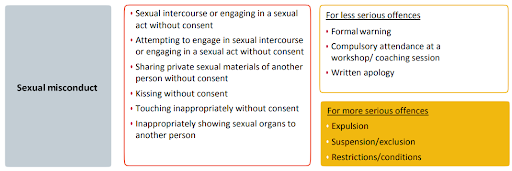
There, sanctions are divided by ‘less serious offences’ and ‘more serious offences.’ Serious offences may result in expulsion, suspension, or unnamed academic restrictions, where for less serious offences the appropriate sanction is a formal warning, compulsory attendance to a workshop or coaching session, or a written apology.
From the examples provided, such as sexual assault and revenge porn (sharing someone else’s private, sexual materials without their consent), it is incomprehensible to consider that an offender would simply be given a warning, attend a one-off workshop, or write an apology to someone they harassed, abused, and likely traumatised.
There is also no mention of how students are active participants in their own case against an offender, including if they are provided any say in sanctions. We contacted SOAS about the SGBV policy and the Student Code of Conduct. A SOAS spokesperson stated the university takes reports of SGBV seriously, and that the SGBV policy was updated earlier this year. They did not clarify what constitutes a ‘less serious offence’ or a ‘more serious offence,’ only that all cases are handled on an individual basis.
The ‘Enough is Enough’ campaign began in 2015 with an aim to reduce sexual harassment and assault on campus by educating students on consent. Mandatory workshops for new students are a large part of the campaign.
This year, fresher students were not allocated a consent workshop to attend due to a Student Information System’s (SIT’s) migration impacting timetabling systems - changing where student information is stored. However, it remains unclear on whether those who did not attend a workshop have since been contacted and invited to attend one, and whether there will be penalties for non-compliance.
There are also questions regarding the effectiveness of the workshops. Facilitation was minimal; rather than making students critically engage with the discussion, participants were presented a PowerPoint, read a script, and made to watch a video that uses tea-drinking as an analogy for sex, which has been widely criticised for being opaque and unhelpful.
Perhaps SOAS has something to learn from the Cornell case. In an interview with National Public Radio (NPR), The Cornell Daily Sun’s Editor-in-Chief, Sophia Dasser said, ‘It’s quite obvious to anyone that those who would carry out the sexual assault would most likely not be sitting in a voluntary sexual assault workshop.’
So when institutions fail us, who then can we turn to? For Jane Doe (the plaintiff in the Cornell University case), it was their student paper, The Cornell Daily Sun, who continually reported on her case - even when the university had dropped it.
Particularly when it comes to on-campus issues, universities seem to care more about their own reputation than supporting their students. Seeing my own friends' experiences go unheard because of insufficient evidence or complexities in the case is a stark reminder that sometimes we have to write our own justice.
As Dasser noted during her interview with NPR: ‘This is not a dark chapter in Cornell’s history. It reflects a culture that the university has not yet confronted.’
SOAS’s current attempts to prevent sexual violence on campus feel pathetic. A 2025 survey by the Office for Students found that 14% of UK students have been victims of sexual assault. With statistics this high, and cases being raised every year, an hour-long workshop comparing consent to ‘making a cup of tea’ just doesn’t cut it.
Between poorly organised workshops, and constant paperwork for anyone wishing to report sexual violence, it feels like the odds are constantly stacked against us. And when a university cannot even send out an email about their mandatory consent workshop, how can we trust them with our welfare?
Will the Cornell case finally inspire an overhaul in how universities tackle sexual violence? One can only dream. In the meantime, here is to every Jane Doe who continues to persist, despite everything they have endured.
If you or someone you know has experienced any of the subjects raised in this article, you can contact Rape Crisis England & Wales for confidential support on 0808 500 2222.