The Korean Table: A Journey into Korean Meal Culture and Heritage
Written by Hyunseok Henry Ryu, Staff Writer, LLM Master of Law.
Food is one of the constants in our lives, influencing culture through its very creation. The National Museum of Korea’s current exhibition, ‘The Korean Table: Food, Nature and Life,’ perfectly encapsulates the deeper meaning of food.
The exhibition invites visitors to reconsider what it means to prepare and share a meal, exploring Korean food culture through its techniques, history, and dishes.
Visitors are greeted by a wall where they can share what a meal means to them. Notes of ‘chicken’ (an essential part in the Korean diet) and cute drawings of meal platters symbolise the human connection and warmth that shared meals can carry.
For Koreans especially, even greetings can become a reference to food. For example, your friend or your parents might greet you by asking ‘have you eaten?/밥 먹었어?’; or, when asking a friend to meet again soon, you might say ‘let’s get a meal next time/밥 한번 먹자’. Koreans are a people that live to eat, and it shows in the everyday language.
"The exhibition reminds us that a meal is not only about the food we consume but also the experiences we gain and the people we meet."
The exhibition features many artefacts of bowls and dishes dating back to the 1st and 2nd centuries BCE. These offer a chance for us to be reminded of the depth of our history. Even back then, Koreans were eating in plates and bowls that hold big portions and banchan (Korean side dishes).
The Joseon Dynasty guidebook explains how to set up a Korean meal table by showing where to place the rice, soup, seaweed, among other banchan. There are certain components to a full Korean meal that cannot be excluded, and this book shows how far back the Korean need for rice and banchan goes - how we live today is no accident, but built upon thousands of years of history.
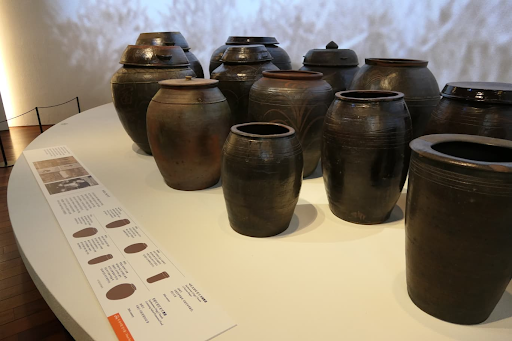
Onggi are a common sight in Korea. They are earthenware jars used to ferment foods like kimchi, doenjang, gochujang, and soy sauce. These jars are porous and historically would be buried underground as an early form of refrigeration. They are still used today as they provide perfect conditions for fermentation. While onggi share similar designs, they vary slightly in each region of Korea, inspired by the varieties of approaches to cooking across the country.
Other items on display include paintings of historical feasts, and dining tables inlaid with mother of pearl - a traditional Korean technique reminding us of the beauty of everyday objects.
The exhibition reminds us that a meal is not only about the food we consume but also the experiences we gain and the people we meet.
The exhibition ends with the quote: ‘even the King eats barley when he is hungry.’ Barley was seen as a lowly peasant grain, but it is nutritious and fed most of the population. This reminds us that, despite our differences in class and background, in the meal we are all one, and that one meal is us all.