The Palestinian Pop Artists to Replace Ed Sheeran on Your Playlist
Written by Silvia Battaglia, MA Anthropology of the Environment and Sustainability.
Perhaps there is nothing more satisfying than finally seeing an artist face the consequences of their incomprehensible actions. For megastar Ed Sheeran, who is facing international backlash after dropping Macklemore from his tour over the rapper’s support for Palestine, the future seems bleak.
In response to the debacle, Sheeran offered a 2010s-style YouTuber apology, which did nothing but help plummet his career. Social media was quick to respond, questioning ‘whose love matters,’ ‘what kind of love does Sheeran refer to,’ and ‘are there other artists whose music reflects a more inclusive, wide, and fluid, healthy idea of love?’
Sheeran’s romantic pop music was the backbone of my generation’s musical taste for over a decade. Even if you weren’t a fan, his songs were inescapable.
At the turn of the 2010s, tracks like ‘Give Me Love’ and James Blunt’s ‘You’re Beautiful’ were all over the radio. Sheeran’s music even featured in ‘The Vampire Diaries;’ his songs were sung in the streets, at karaoke nights, stores, and festivals.
Sheeran’s music and lyrics reflected the moods, the dreams, the ideas my generation held about love back then. But after a decade of drastic change in the political landscape, where Artificial Intelligence (AI), feminism, and the live-streamed killing of innocent people have opened our eyes to something entirely different, Sheeran’s lyrics somehow feel stuck in the past.
Songs like ‘Perfect’ or ‘Shape of You’ which, in the global understanding, are about love, fun, and casual sex, feel outdated now. Indeed, a feminist eye would say that they reinforce gender roles, patriarchal expectations about women, and patriarchal views about the woman’s body.
While his earlier songwriting captured a generation and an era in which fast connections and streaming were of no concern in the face of love, Sheeran now seems shielded by the current political landscape - confining his music, words, and preached beliefs about love into a Westernised, seemingly impermeable bubble.
It’s certainly difficult to preach about the universality of love whilst also being bound by the money-making machine that is capitalism - and Sheeran seems to be the biggest victim this year. He has made it clear through teleprompter-read apology speeches that his vision of love has an exclusive audience.
Whether or not we’d like to keep art and politics separated, it may not be possible. Love, the way we love today, is above all political.
While Western artists may disappoint us at times, there are so many fantastic artists out there who sing, celebrate, and speak about love through more unbounded and ethical lenses – and what better language to do so than in Arabic?
"The love they sing about goes beyond romantic love. It is a love for home, community, culture, and slow mornings. It is a love that fits the current geopolitical and ethical issues of our time."
Surely, no artist dominates this genre quite like Saint Levant. The 26-year-old singer from Gaza is grounded in the musical tradition of Bilad-Al-Sham.
A true lover of all things pink, Saint Levant subverts gender roles with ‘Wazira.’ Although the speaker expresses longing and devotion for his exiled lover, the upbeat and celebratory rhythm will have you listening and thinking about romantic love in new ways.
Elyanna is a Palestinian-Chilean singer well known for her experimental blend of Arabic sounds with Latin rhythms and R&B. My personal favourites are her new ‘Bosa,’ where her feminine rage is expressed with sonic loudness and by subverting and turning the male gaze on itself; and ‘Sokkar,’ another feminist take on emotional liberation and independence.
Other tracks from Elyanna, like ‘Olive branch,’ advocate for Palestine, making her and her music not only about female empowerment, but also about cultural devotion, cultural attachment, and human rights justice. She is, in every capacity, the kind of role model we need.
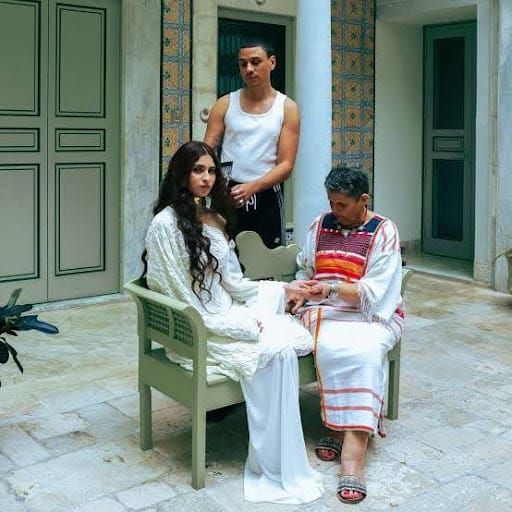
Last but not least of my suggestions is Tära, a pioneer of the Arab&B style. Tära is a force of nature; in just one year, she built a community of almost 280K on Instagram, spread around Europe, North Africa, and the Levant.
Each of her songs deals with her deep love for her Palestinian roots, and her performances place her body as the bridge that upholds and carries her origins into the Italian culture she was born and raised into. My favourite track is ‘Mezzaluna,’ which speaks about her childhood memories of Palestine and her relations in Palestine; her act of remembering makes her feel as if she belongs in the liminal spaces of two worlds.
Tära’s ‘Diaspora’ is also a must-listen-to. It is a song that resists the hypocritical assumptions Europe holds about migration and Islam, and it speaks to every person who’s left home because they’ve felt trapped by political injustices and narrow-mindedness.
These three artists, each with an incredibly unique story, engage with love in different ways. Their various perspectives find commonality in the hunt for tenderness, softness, and kindness hidden in deep emotions and reflections of daily, ordinary life.
The love they sing about goes beyond romantic love. It is a love for home, community, culture, and slow mornings. It is a love that fits the current geopolitical and ethical issues of our time, a love that reflects the concerns of millions of people around the world who see love and solidarity as equal.