Three Years On: What Has Changed Since 7 October?
Written by Pranay Bhalla, BA International Relations and Anthropology.
Three years after Hamas launched attacks on 7 October 2023 and Israel’s subsequent military campaign in Gaza, fighting has decreased, but violence persists. A ceasefire has been in place since 10 October 2025, yet Israeli strikes have continued, most of Gaza remains destroyed, and tensions have spread across the wider Middle East.
The Hamas-led attacks on southern Israel on 7 October 2023 killed around 1,200 people and resulted in 251 people being taken hostage, according to Israeli figures. Israel’s subsequent military campaign has killed more than 74,000 Palestinians in Gaza between 7 October 2023 and October 2026, according to Gaza’s Ministry of Health.
In September 2025, a UN Commission of Inquiry concluded that Israel had committed genocide against Palestinians in Gaza. It found that Israeli authorities and security forces had committed four of the five genocidal acts defined under the Genocide Convention. Israel has rejected the finding.
The ceasefire, which came into effect on 10 October 2025, reduced the scale of fighting but did not end Palestinian deaths. By 30 September 2026, Gaza’s Ministry of Health reported that 1,431 Palestinians had been killed and 5,026 injured since the ceasefire was announced. Israeli strikes have continued, with Israel maintaining that its operations respond to threats and ceasefire violations by Hamas.
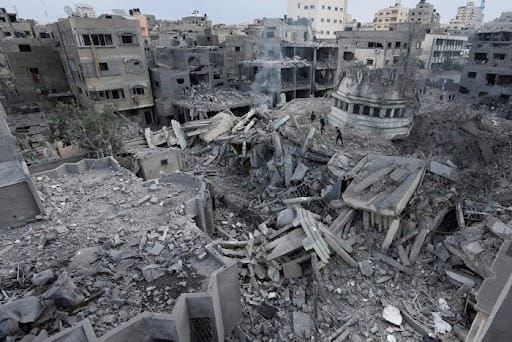
Nearly a year after the ceasefire began, Gaza remains heavily damaged. As of October 2026, Reuters reported that Israeli forces continued to control more than 60% of the territory, while many Palestinians remained in temporary shelters. According to the UN Office for the Coordination of Humanitarian Affairs (OCHA), 94% of Gaza’s population urgently requires shelter assistance. Access to healthcare, clean water, sanitation, and other essential services also remain limited.
As winter approaches, conditions remain particularly difficult for displaced Palestinians. In October 2026, OCHA reported that approximately 279,000 people were living in flood-prone displacement sites or unsafe buildings. Restrictions on essential supplies and shortages of funding have also complicated humanitarian efforts across Gaza.
Palestinians in the occupied West Bank have also faced increasing violence. OCHA documented more than 1,600 Israeli settler attacks resulting in Palestinian casualties or property damage between January and August 2026, affecting 275 Palestinian communities. Israeli military operations, demolitions, and settlement expansion have caused further displacement.
In September 2026, OCHA reported that more than 4,300 Palestinians had been displaced across the West Bank since the beginning of the year due to demolitions, evictions, settler violence, and restrictions on movement.
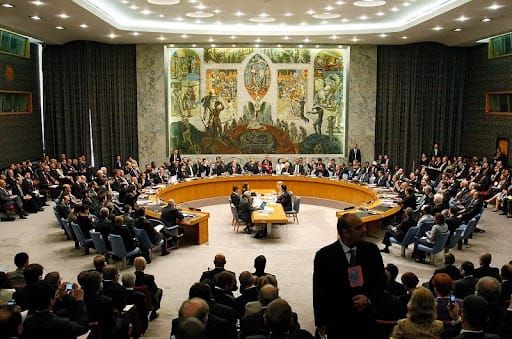
In September 2026, UN Secretary-General António Guterres warned that accelerating Israeli settlement expansion was undermining the possibility of creating a viable and contiguous Palestinian state.
Further, the consequences of the conflict have extended across the Middle East. The confrontation between Israel and Iran escalated into direct war, with the United States and Israel launching attacks on Iran in February 2026. Iran subsequently launched missiles and drones towards Israel and Gulf states hosting US military bases.
Energy infrastructure across the Gulf has also been affected. Iranian attacks damaged facilities in Qatar and Saudi Arabia, while facilities in Kuwait, the UAE, and Bahrain were also targeted or disrupted. Qatar has attempted to support negotiations between Iran and the United States as regional tensions continue.
"Three years after 7 October, Palestinians continue to face violence and displacement, while the effects of the conflict have spread across the wider Middle East."
The escalation has placed Gulf states at the centre of growing regional tensions, particularly because several of these states host US military bases. The expansion of the conflict has raised concerns over further attacks, regional instability, and disruption to global energy supplies.
The economic consequences have extended far beyond the region. The International Energy Agency described the disruption caused by the Middle East conflict as the largest oil-supply disruption in the history of the global oil market. Around 20% of global oil consumption would have ordinarily passed through the Strait of Hormuz, where shipping has been severely disrupted.
These consequences have reached British consumers. On 2 October 2026, the RAC reported that average UK diesel prices had reached a record 200.01 pence per litre. Filling a typical 55-litre diesel tank cost approximately £110, placing further pressure on household budgets.
International policy towards Palestine has also changed. On 21 September 2025, the United Kingdom, Canada, Australia, and Portugal formally recognised the State of Palestine, joining more than 140 countries that had already done so.
Israel strongly opposed the decisions. Israeli Prime Minister Benjamin Netanyahu argued that recognising Palestine following the 7 October attacks rewarded terrorism. The governments recognising Palestine instead argued that recognition was intended to protect the possibility of a two-state solution.
However, developments on the ground have raised questions over whether that solution remains achievable. The UN continues to support independent Israeli and Palestinian states based on pre-1967 lines, while warning that Israeli settlement expansion, displacement, and territorial fragmentation threaten the possibility of establishing a viable and contiguous Palestinian state.
The recognition of Palestine marked a significant diplomatic shift among several Western governments. However, recognition has not changed conditions on the ground, where continued settlement expansion and displacement remain major obstacles to the creation of a Palestinian state.
Three years after 7 October 2023, 74,484 Palestinians have been killed, much of Gaza remains destroyed, and Palestinians in the West Bank continue to face violence and displacement. Meanwhile, the conflict has developed into a wider regional crisis with consequences for populations across the region and the global economy. Despite increased international recognition of Palestine, a lasting political settlement remains uncertain.