Trump-Xi Summit: A Belt and Road across the Pacific?
Written by Rhena Kotecha, BA Politics and International Relations.
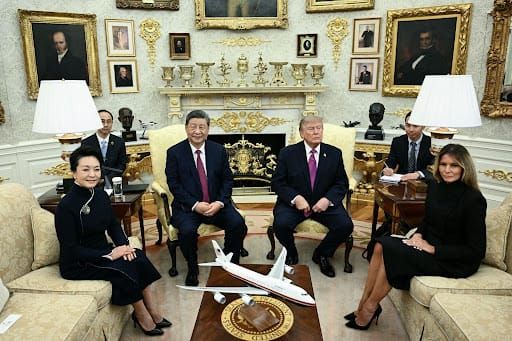
President Xi Jinping and First Lady Peng Liyuan were personally welcomed by President Donald Trump and First Lady Melania Trump at Joint Base Andrews on 23 September, 2026. A ceremonial military display was unveiled before the two leaders headed to the Oval Office, where an array of matters were discussed, from technology to Taiwan and Tehran.
"From the extravagant welcome, to a lavish state dinner and a tour of the National Archives - were the ostentations of the Xi-Trump summit strong enough to ease the political deadlock between Washington and Beijing? "
At first glance, an easing of tensions seemed probable, as the leaders announced their decision to extend the Busan Agreement. Originally set to end on 10 November 2026, the agreement sought to resolve the tariff war between the rival nations, which has now been extended to 10 January 2027. This, alongside Xi’s statement that ‘The Thucydides Trap can be overcome’, signals a potential commitment to conflict avoidance from both sides.
However, regarding the respective nations’ geopolitical concerns, the prospect of a settlement remains out of reach. Whilst Trump has asked Xi to join US efforts in economically isolating Tehran, China is still Iran’s top trade partner, having received up to 90% of Iran’s oil exports since the US and Israel initiated the war on Iran in February. Xi’s stance remains unwavering as he continues to encourage the US and Iran to negotiate without any external mediators.
Similarly, whilst Xi urged Trump to oppose Taiwanese independence, the US remains tactical in its approach to the delicate matter. Trump’s postponement of the $14bn arms package that was set for Taipei in May remains, but the White House is yet to publish its own summary of the meeting outcomes regarding Taiwan.
Finally, regarding the highly anticipated talks concerning the race in AI development, the White House stated that an agreement had been reached between the two contending nations to establish a ‘bilateral communication channel’ for AI occurrences. However, Trump’s statement that he ‘would rather not integrate’ with China due to the US’ leading position in terms of AI expansion suggests otherwise.
From the extravagant welcome to a lavish state dinner and a tour of the National Archives, were the ostentations of the Trump-Xi summit strong enough to ease the political deadlock between Washington and Beijing? Whilst the truce between the two has been prolonged, its short extension period showcases the lack of concrete action being taken by either side to settle the struggle. Furthermore, geopolitical issues and the intensifying race in AI advancement remain unresolved. Trump and Xi are set to meet twice more this year; however, following the pattern of their meeting in May and this latest summit, it remains doubtful that China and the US’ heated rivalry will cool off.